Friday, March 28, 2008

RIVER SIGHTING

I work in the historic downtown warehouse district, and my building is only four short blocks from the Mississippi River. The city has put effort into developing the river in this part of town, so there's a lovely pedestrian walkway all along the water, places to sit, and an old railway bridge across the water that is now a popular path for joggers, pedestrians, and the tourist trolley that runs through the city in the spring and summer.

One day this week, wanting to clear my head, I went to the river at my lunch break. I like walking across the railway bridge for its view of the lock and dam, for the little garden at the far end, and for the ducks and geese that congregate in the warm waters near the power plant along the river's banks. As I was meditating on the things that were bothering me, I looked casually toward one of the small streams that feeds the river by the power plant and locked eyes with an eagle perched in the tree branches. We stared at each other, and I slowly approached his side of the bridge for a closer look. He kept me in his sight as I moved toward him, studying his markings and colors to make sure it was an eagle. And, indeed, when I got home that evening and checked my Peterson field guide, it was indisputable. I'd seen an eagle. A bald eagle.
Turns out the Mississippi River is a major flyway for the birds, who, just like the more prosaic ducks and geese, are attracted to the warm waters near the power plant. The water there is fairly shallow, the fishing is good, and there's even a little sandbar that peaks above the surface--a sort of bird beach. As I continued on my way, I realized I felt happy and lighter in spirit. So next time I feel the weight of human folly, I'm heading back to that spot along the river for the Raptor Cure!

Sunday, March 23, 2008


FRENCH TOAST FOR EASTER


Every Easter for the last several years, SJG and I have hosted our friend Marion for breakfast at our house. We often make up a small Easter basket for her with her favorite candies. This year the Easter basket was pot roast and mashed potatoes from last night's meal. Marion is almost 94 and doesn't cook much for herself anymore, so she was more excited about her Easter basket than you might imagine.


For Easter breakfast this year, I made my absolute favorite French toast recipe, which I found in the local newspaper many years ago. It requires overnight soaking but is otherwise an easy, no-fail recipe that will wow your guests.


French Toast Extraordinaire


6 eggs
1-1/2 cups half-and-half
1 tsp vanilla
2 tsp sugar
1/4 tsp salt
1/4 tsp cinnamon
one day-old baguette or ciabatta loaf, cut into 1-inch slices on the diagonal for maximum surface (you can also buy a fresh baguette or ciabatta, slice it up, and allow the slices to dry for several hours ahead of time)

1) Mix the eggs, cream, vanilla, sugar, salt, and cinnamon in a medium-sized bowl.
2) Arrange the slices of dried bread in a large, shallow baking dish (9 x 13).
3) Pour the egg mixture over the bread and turn the slices at least once to make sure the liquid soaks into each slice. Cover with plastic wrap and refrigerate overnight.
4) The next morning, heat the oven to 450 degrees.
5) While the oven is heating, fry the slices of bread in butter on a hot griddle until browned nicely on each side.
6) Transfer the fried slices onto a lightly greased baking sheet (or two) and bake in the hot oven for 5-7 minutes until puffy. Serves 3-4 people.

*Sliced fresh fruit is a lovely accompaniment. We served fresh strawberries this time, along with thick-sliced bacon and freshly squeezed orange juice.

**Notice the tea towel in the photo above? I embroidered it when I was 10 years old. Embroidery is a skill that my mother forced upon my sister and me but for which I am now extremely grateful.

Sunday, March 16, 2008

SHRIMP MOLCAJETE
I've been looking for a recipe for shrimp molcajete (public photo above from flickr.com). In surfing for information this morning, it appears that, like SJG and me, many vacationers have been introduced to this lovely dish while in western coastal Mexico or in parts of the American Southwest. Recipes abound for making guacamole or salsa in a molcajete (mortar and pestle), but I found only one recipe--on the BBC website--for making the stewlike dish we had in Mazatlan. My adapted version goes something like this (and doesn't quite match the looks of the photo above, by the way):
Salsa
2 cloves garlic
1 chipotle chili
1 small onion, chopped
1 bunch fresh coriander
1 small can of chopped tomatoes
salt and pepper, to taste


Meat/Shrimp Base
1-2 chicken breasts, 3/4-1 lb sirloin steak, or 1 lb peeled and deveined shrimp
1-2 tablespoons olive oil
salt and pepper, to taste
1-2 bunches green onions
several whole jalapenos (on the large side), seeded to reduce the heat

Trimmings
8-12 warm flour tortillas
1/2 bunch coriander, chopped
1-2 avocados, sliced
1-2 limes, sliced
1-2 cans refried beans, warmed up

1. FOR THE SALSA: mash the garlic, chili, onion and coriander in a large seasoned molcajete.
2. Add the tomatoes and mix to combine. Season to taste with salt and pepper.
3. Place the molcajete over high heat and bring to a boil. Reduce the heat and simmer for 15-20 minutes. Keep warm until ready to serve. (In Mexico, each person gets an individual molcajete, so this step may take up the entire stovetop.)
Caution: the molcajete gets very hot. Use hotpads or kitchen mits to handle.

4. FOR THE BASE: Season the meat or shrimp to taste. Saute in olive oil in a large skillet on the stovetop or grill under the broiler or on an outdoor grill until done. Slice the meat into strips. Shrimp can be served as is.

5. Briefly grill the green onions and the jalapenos on the broiler setting of the oven or on the outdoor grill until nicely browned.

6. TO SERVE: place the meat or shrimp (or combination of the two) in the molcajete(s) with the warm salsa. Drape the grilled onions over the sides (with the onion head in the salsa and the green stems lying over the edge) and garnish with grilled jalapenos, chopped coriander, and sliced avocado. Serve with warmed tortillas and refried beans on the side. As in the photo above, beer is a nice accompanying beverage for this dish. Fresh lime can be squeezed into the beer or over the meat just before eating.

Saturday, March 01, 2008

FISH HIT

Last February, in Tucson, you'll remember I was hit by a flying hamburger (see the February 24, 2007, posting entitled "In Such a Landscape"). This year, in Mazatlan, as SJG and I were strolling along the beach on our afternoon walk, I was hit by a fish, released from on high by one of the many gulls for whom our stretch of beach was prime feeding grounds. It was a small white fish, not as lovely as the carp in the print above by Aleah Koury, but a fish all the same. The gull seemed confused and circled above us in search of his lost fish. The sea waters carried it back into the ocean before the gull could retrieve it, and SJG and I moved on, wondering why I seem to be a prime target for these kinds of things.
At work this week, SJG reported the Fish Hit to one of her colleagues. He claims that it's well known that being hit by a fish is very good luck. I did a little googling this morning to see if this is indeed true but didn't easily find anything to confirm the assertion, other than the fact that fish are generally omens of good luck in Asian cultures. I'll have to do a little more research on the Fish Hit in particular, but in the meantime, my googling did turn up a CNN video clip from 2007 that documents a variety of very funny fish hits. Here's the link: http://www.cnn.com/video/#/video/moos/2007/06/23/moos.fish.smacked.affl
(then click on "Fish Smacked" option to the right of the video screen)
Good luck!

Monday, February 25, 2008


MOONSET

We watched the lunar eclipse from a neighborhood street in Mazatlan, where we had come for dinner at the invitation of the Mazatlan in-laws of one of SJG's colleagues. They sat us like royalty at a long table on their front patio and served us homemade gorditas and quesadillas, stuffed with grilled beef. Only after we'd finished our meal did the family sit down to eat.

The next morning, I awoke at 6 o'clock--unusually early for me--and walked out onto the hotel patio facing the sea. To the south, the full moon was setting in a sky blushing pink from the rays of the rising sun. Pelicans skimmed the crests of the waves as they crashed onto the beach, and a lone fisherman cast his net into the waters from a rocky point under the moon.

Tuesday, February 12, 2008

FINNA!
Finna is our bruiser cat, the one who talks tough but has a marshmallow heart. The one who loves to snuggle under the covers when I crawl into bed at night and who purrs when you look at her. She's the smartest of our three cats, too. She knows how to open doors and cupboards, while the other two watch and marvel. She's the one who bit our toes and climbed the curtains when we brought her home. But she's the one they said was "bunny soft." And she is. Who can resist?

Wednesday, February 06, 2008


CAUCUS 2008!

I live in a caucus state. I am not, however, a group person and so have stayed clear of participation. I feared the pressures of public declaration of my political sentiments, some of which are gut feeling as much as rational intellectual thought. I feared the long night of arguing arcane resolutions and suffering the monologuists. And I didn't like the idea that, at a caucus, they don't serve cookies and cake.

This year the state Democratic party (okay, so I'm a Democrat) changed the way they organize caucuses and it became possible to simply show up, vote, and go home. I decided I could handle that, so last night--the night of our Super Tuesday presidential caucus--SJG and I headed to a nearby high school to be in line as they opened the doors at 6:30 pm.

I have to say it was fun. With triple the number of participants, the caucus was overflowing with people eager to cast their vote. I waved happily at all my neighbors, most of whom I know from walking Buddy every day and meeting their dogs. And since I live in a place where order is next to godliness, the entire caucus process went smoothly and efficiently. I wrote the name of my candidate on a little yellow post-it note (they'd run out of ballots) and pushed it into the slot of the Folger's coffee can the precinct volunteer held out to me. And then she pointed me to the table behind her, where cookies and cake awaited voters like the prize I had long imagined they should be.

Friday, February 01, 2008

NO BAD WORDS WERE FOUND

I rated my blog through the following link: http://www.justsayhi.com/bb/blog_rating

It's like rating a movie to see what the target audience might be. My blog rating came back as "G: General Audiences All Ages Admitted" with the delightful commentary that "no bad words were found." Whew, what a relief.

I don't quite believe that the rating is particularly valid, however, because my sister's blog came back with an NC-17 rating (No One 17 and under Admitted) based on the usage of the following "bad words," some of which occur on my blog too:

death (27x) dead (10x) pain (9x)
fuck (8x) fucks (3x) dyke (7x)
suicide (4x) breast (1x)

I haven't quite decided if I should up the quotient of "bad words" on my blog or not (I probably already have by listing the above "bad words"). Which is a more desirable audience, the general family crowd or those naughty adults?

Tuesday, January 22, 2008


WHAT'S FOR DINNER? (Monday)

Chili! SJG makes her chili with a variety of different meats and beans. This week's chili has pinto beans and pork tenderloin. Try ground beef and black beans, or ground turkey and red beans as alternatives. We put chopped green onions and grated cheddar (a mild four-year Widmer) on top of each serving, with a dollop of sour cream or cottage cheese on top of that. With a piece of cornbread, this is a satisfying meal on a cold winter night. (Tuesday's high will be ten degrees above zero where we live!)

Saturday, January 19, 2008

WHAT'S FOR DINNER? (Friday)

Pizza margherita! We order pizza for home delivery every Friday, as a reward for our week of work. The last few weeks, we've tried a new, hip pizza joint but have decided that it's really only good for meat pizzas. Last night, we were in the mood for a classic pizza margherita--mozzarella, fresh tomatoes, and basil chiffonade--and for that, we prefer to order from the Italian deli in our neighborhood. They're generous with the cheese and the basil and make a nice light crust that doesn't overwhelm the toppings. With a green salad on the side, it makes a very satisfying meal.
This pizza is named for Italy's Queen Margherita, by the way, who wore the crown in the late nineteenth century and for whom Italy's earliest pizzas were apparently made. (Pizza originated in subcontinental Asia, not in Europe.)

Thursday, January 17, 2008


WHAT'S FOR DESSERT? (Thursday)

Galatopoureko! It's a Greek dessert made of phyllo dough filled with nutmeg-flavored custard and drizzled with honey. My sister and I shared a piece after dinner this evening at our favorite Greek restaurant in her neighborhood. In the kitchen, they make the galatopoureko when you order it and sprinkle the plate with decorative flourishes of ground cinnamon. In the restaurant, with its white and blue walls and the flowering plants all along the bank of windows that faces the street, it's like stepping into a little corner of Greece far away from the frosty cold of our city, where tonight, the air temperature is 9 below zero.

Wednesday, January 16, 2008


WHAT'S FOR BREAKFAST? (Wednesday)

Raspberry-bran muffins! For five years, I made bran muffins every Sunday. But then I tired of it. So, ever since, it's been SJG's job. She doubles (or maybe triples) my original recipe so she doesn't have to bake every weekend, and she adds all kinds of extra ingredients that I would never have dreamed of--millet, ground flax seeds, raw sunflower seeds, oat instead of wheat bran, and more bananas than you really want to know about. I eat two every morning at my desk. They're delicious, and they do the trick!

Monday, January 14, 2008


WHAT'S FOR DINNER? (Monday)

SJG usually makes a pot of soup on Sunday for the week. She consults with me, and this week, I had a vision of red beans and rice, so that's what she made. She adds dinosaur kale, for the dark green leafies, and heads over to the other side of town for smoked ham hocks. We serve this soup with homemade cornbread, the recipe for which I've posted below.


CORNBREAD

1-1/4 cups flour
3/4 cup cornmeal
1/4 cup sugar
2 teaspoons baking powder
1/2 teaspoon salt
1-1/2 cups buttermilk
1/4 oil (melted butter is even better)
1 egg, beaten (2 eggs is even better)
1 cup frozen corn (creamed corn is even better)

1. Mix the dry ingredients together.

2. Stir in the buttermilk, oil, and egg. Add the frozen corn. Do not overmix.

3. Pour into a greased cast iron skillet (8-in diameter) or other low, flat baking dish of about the same size. (Greasing the pan with canola oil is good for you, but melted butter is even better.)

Bake at 400 degrees for 20-25 minutes until the top is golden and the cornbread has started to pull away from the sides of the pan.

Sunday, January 13, 2008


MORNING COFFEE

I start every day with a cup or two of espresso, latte style. The paraphernalia all (well, mostly all) has links to my family: the green and white ceramic mug comes from my sister; the slim white English porcelain creamer in which I foam the milk is from my mother; the silver spoon is something my father got at a long-ago auction in Missouri; and the espresso maker, well, that's standard-issue Ikea, my new favorite place to shop.

Monday, January 07, 2008


THEME PARTY

We celebrated my father's seventy-seventh birthday (January 8) this past weekend. The theme? Antarctica, heavy on the penguins. All the presents had something to do with penguins, including the cake!

Saturday, January 05, 2008


IN ANTARCTICA
And here's my father's snow penguin onboard the Nordnorge in Antarctica!

Tuesday, January 01, 2008


POBLANOS RELLENOS FOR THE NEW YEAR

SJG and I dispensed with traditional roast turkey for holiday eating this year and instead prepared Mexican feasts. For Christmas Eve, we made fajitas with beef tenderloin, and we rang in New Year 2008 last night with poblanos rellenos, inspired by a version I had in San Antonio this fall. A simple dish to prepare, it looks beautiful on the plate and tastes heavenly. Happy New Year!

Poblanos Rellenos

(adapted from The Border Cookbook by Cheryl Alters Jamison and Bill Jamison, 1995)

  • 6 large, fresh poblano chiles--roasted and slit from one end to the other
  • one medium yellow onion, chopped
  • 4-5 cloves garlic, chopped
  • 1-1/4 pounds ground beef
  • 1 tablespoon ancho chile powder
  • 1 tablespoon regular, mild chile powder
  • 1 teaspoon ground cumin
  • salt, to taste
  • 1/3 cup raisins
  • 3 tablespoons chopped, fresh cilantro
  • 1 tablespoon worcestershire sauce
  • juice of 2 limes
  • 2 cups grated Monterey jack (or other mild white cheese)
1. Core and seed the poblanos. Roast in the oven on a cookie sheet until the skins soften and begin to turn black. Set aside.

2. In a large skillet, saute the onion and garlic in a little olive oil (about one tablespoon).

3. Brown the beef in a separate pan.

4. When the onions and garlic have softened, add the browned beef.

5. Stir in the spices, raisins, cilantro, worcestershire sauce, lime juice, and half of the cheese.

6. Place the poblanos on a cookie sheet lined with tin foil. Stuff them with the spiced meat and sprinkle the rest of the cheese over the peppers.

7. Heat the peppers in a 375-degree oven for about 5 minutes, until the cheese has melted.

Serve with refried beans (with a little melted cheese and green onions on top), rice, guacamole, and chips. Delicious!

Friday, November 16, 2007

INTO THE MIDDLE DISTANCE

They came to the surface in bright red blotches, some the size of a fist, and in all the worst places--groin, armpits, nape of the neck, scalp. They erupted on the inside of the bottom lip, pushing the flesh forward into a collagen pout, Hollywood style.

Waiting in the emergency room lounge, she wondered if other people could see her hives ballooning under her clothes, like she could see the raw wound on the ankle of the man next to her. Yet most patients avoided eye contact, staring straight ahead into the middle distance or up at the wall-mounted television. They weren't looking at anything really, just waiting in silence for their turn with a doctor.

A few days later, the antihistamines and steroids had cleared up the hives, and the first round of allergy tests had revealed nothing. So, equipped with a bag full of EpiPens, she headed to the airport for the business trip to Texas, balancing her fears of another outbreak against the perky optimism of her sister.

"It's a one-off thing," her sister had said. "It'll never happen again. You're fine."

On the flight, half empty, the passengers sat quietly, many of them still groggy from the early morning departure. She greeted the travelers on either side, falling into conversation with the man in the window seat to her left. His accent marked him as a Southerner, Texan she assumed, although he quickly set her straight.

"Morgan City, Louisiana," he said. "But I'm going to Trinidad." In the oil business, he clarified, building platforms. Six weeks on, two weeks off.

He had left his wife up north with their son at the big university hospital there. "A blood disorder," he said. "We've been tracking him for six years now. It was finally time for the bone marrow transplant this summer. But I don't know. His white count keeps going down...." His voice trailed off as he looked down at the seat cushion separating them, a sort of no-man's land where answers might lie.

She offered a few words of sympathy, wondering if he could see in her, and in her words, the knowledge of sorrow she carried too. He turned toward the window and she to her book thinking that, maybe like the patients in the emergency room, we most of us carry our wounds outside of plain view, and only through chance, or magical X-ray vision, do they come into view. Or maybe they're always there, bulging at the surface like red, angry hives. It's just that we're staring so hard into the middle distance that we safely avoid them.

"I wish the best for your son," she said to the man as they walked off the plane. He nodded. " 'Preciate that," he said, as they headed their separate ways, she to the shuttle that would take her to her downtown hotel, he to the far end of the airport for the long flight to an oil platform in the middle of the sea.

Friday, October 26, 2007


HAPPY HALLOWEEN!


My father often comes to visit for Halloween so we can carve pumpkins together. It's an all-day affair involving much planning and an ever-changing set of tools. One of the best discoveries came to us via Martha Stewart, whose show my father used to watch at the gym. She says that an ice cream scoop is the best implement for carving out the guts of a pumpkin, and indeed it is.


One year, my father brought his power drill, and we drilled patterns in our pumpkins. He created a witch on a broomstick, and I made random geometric patterns. Another year, we stenciled our pumpkins and cut out moons and stars.


This year, my father's not coming for pumpkin carving, and I haven't been inspired to do it on my own. But, one day this week while I was walking Buddy, I noticed that the little shop around the corner had two pumpkins on the stoop, each one decorated with various pieces of hardware and twisted wires. Delighted, I ran out to choose my own pumpkin, and today I dug around in the basement to collect an assortment of hardware odds and ends of my own. I even found a spool of wire and a pair of wire cutters to make twisted lengths of hardware hair.


The beauty of this approach to "carving" a pumpkin is that it requires no carving. Once you have the pumpkin and the hardware, you simply screw in the hardware eyes and nose and mouth and ears and hair in whatever arrangement is pleasing to you, and voila! Hardware Pumpkin Man is ready. Happy Halloween!

Monday, October 08, 2007

SJG

What is she to me?

She is the one they wave to, bus drivers, children, all the neighbors, colleagues in the elevator, mechanics, strangers too.

She is the dancing girl, grinning for the camera in the Luxembourg Gardens.

She is softness in the dark, warm hands that cup my curves.

She is memory, Helen’s kitchen, its pies, fried chicken, eggs and bacon and coffee, Swiss steaks, TV dinners (just the good parts); Bud and Bob’s on Sunday afternoons; Edna’s Christmas cookies, pork cutlets fried just right, pickles (no garlic), endless Jell-O salads, and the fudge the dog ate (was it Tinkerbelle?).

She is the Big Pool, cold limbs pulling in cement’s warmth, plunging back into the waters to start the cycle again, cool waters, warm cement, cool waters, warm cement, a body-firing in summer’s heat.

She is radiance of golden energy, the aura that pulls me in.

She is the one to make me laugh (even though I did once say she isn’t funny), to show me humor in tragedy in absurdity in myself sometimes.

She is the one who knows sorrow, balancing joy on its precipice.

She is the one who sees beauty in silence, snowflakes drifting out of grey sky, yellow leaf settling on lake’s surface, orange fire-moon rising from the horizon.

She is the girl in the dark alley, the one to whom I said, “I need you.”

She is the woman I love.

--on the occasion of our twenty-fifth anniversary

Tuesday, August 21, 2007


AUGUST BOUNTY

Phlox bloom in my garden in the hot, humid days of August, when the nights begin to cool and the gentlest touch of autumn is in the air. In this part of the world, the harvest is at its ripest now. Roadside farmers secret extra ears of corn into each bag, green beans spill out of marketplace baskets and cartons, and luscious, ripe tomatoes, once treasures, weigh the basket as commonplace loads.

Saturated with bounty, August yet calls forth a note of sadness in the evening cicada’s song, its single-note melody somehow lonesome, its empty carapace a morningtime souvenir of another lifetime. As children, we prodded the insect’s shell and sipped the tender sap of phlox’s flower. Still these tokens take me there, to that youthful place of song and fruit and endless, wondrous mystery.

Sunday, July 08, 2007


GRILLED PIZZA

Oblivious to the ozone warning on a recent hot, steamy day in our nation’s capital, my father and I headed out for sightseeing. We took the Metro and then the city bus to Mount Vernon, the property just outside of Washington, D.C., that George and Martha Washington called home. The house itself is surprisingly modest, yet it is in an incomparable setting. Perched on a bluff overlooking the Potomac, the site commands a wide, impressive view of the river and surrounding lands. We took full advantage of the Washingtons’ verandah and the cooling breezes that wafted up to us there from the river below. Sitting on simple wooden chairs, we wondered if Martha served George iced tea or mint juleps on hot summer days more than two hundred years ago.

Today, back at home, it’s similarly hot and muggy. Air temperatures are in the high nineties and the dew point is somewhere close to seventy. We have more pedestrian concerns before us than to wonder what George and Martha sipped on their back porch. We have dinner to make, and in oppressive heat. The solution? Pizza on the grill outside. It’s amazingly quick and easy!

Pizza Dough
To make things simple, buy prepackaged pizza dough. Otherwise, you can make your own dough as follows:

1 package quick-rising yeast
1 teaspoon sugar
1 cup hot water (between 105-115 degrees)
3 cups flour
1 teaspoon salt
¼ cup olive oil
1 tablespoon fresh rosemary, choppped

1. Sprinkle the yeast and sugar into a cup of hot water. Let sit for about 10 minutes, until the yeast bubbles nicely.
2. Meanwhile, mix the flour and salt in a large mixing bowl. When the yeast is ready, pour into the flour and stir. Add the olive oil and rosemary. Stir until well blended and slightly tacky to the touch.
3. Knead the dough on a lightly floured surface for about 10 minutes.
4. Place the dough in a large bowl lightly oiled with olive oil. Cover with plastic wrap or a kitchen towel and let the dough rise in a warm, draft-free place for about an hour. The dough will easily double in size.
5. When the dough has risen, punch it down gently and divide into four pieces.
6. Shape each piece into an 8-inch round (or as close thereto as you can). You can either do this with your fingers and hands or with a rolling pin.
7. Place each piece of dough onto an individual, oiled pizza pan, cutting board, or large plate. Cover with towels or plastic wrap and allow to rise another 30-60 minutes. Meanwhile, prepare your toppings.

Toppings
You can use your favorite prepackaged pizza toppings: grated cheese, sliced meats, olives, sliced vegetables (which you’ll then want to roast or sautĂ© ahead of time), and whatever else appeals to you. I roasted my own garlic (one big bulb in the oven early in the morning), roasted my own vegetables (two eggplants and two red peppers; see the previous “Rear Window” blog entry for how-to information), bought two small containers of local goat cheese, and grated about 3 cups of domestic mozzarella.

To prepare the pizzas:

1. Preheat the grill.
2. When the grill is ready, turn to medium heat. Brush a little olive oil on one side of each pizza round. Place the pizza rounds directly onto the grill, oiled side down. My grill fits two rounds at a time, but if you have a larger grill, you can do all four at once. I found it easiest to pick up the rounds with my hands and place each one gently onto the grill.
3. Grill each piece quickly for about 1 or 2 minutes, with the lid down, just until the dough has set. It may begin to turn brown and take on lovely grill streaks.
4. Remove each pizza round from the grill, using tongs. Take them back into the kitchen and lightly brush the ungrilled side of the dough with a little more olive oil. Then arrange the toppings of your choice onto the grilled side of each round. I started with the roasted garlic, then a little grated mozzarella, then the roasted veggies, then the goat cheese and a bit more mozzarella. Drizzle each pizza with a little olive oil or vinaigrette (homemade or bottled both work).
5. Return the pizza rounds to the grill, topping side up and ungrilled side down. Close the lid of the grill and allow the cheese to melt. This takes about 5 minutes.
6. Remove the individual pizzas from grill using tongs. Serve the pizzas with a simple green salad. Enjoy!

*Makes four individual 8-inch pizzas, enough to feed 4-6 people.

Friday, June 29, 2007

REAR WINDOW

An alley. Three adult men and a young boy pass by, their laughter and voices floating up to where we sit on a back porch three flights up. Loud music blasts out of an apartment across the way. A light comes on in a nearby window. A man comes into view, wearing only his underpants. He walks over to the computer in his study. The window at his desk is shaded and the man disappears into shadow profile. The music stops. An alley inhabitant, drinking his evening beer at the dumpster below, applauds. Summer in Chicago.

We’ve come to visit friends in the city for my birthday weekend. The alley scene is our own private rear window, like the memorable Hitchcock film starring James Stewart as the voyeur and Grace Kelly as his intrepid love interest. As in that movie (set in New York), here in Chicago we have a view into the lives of strangers whose stories we can only guess at. Poverty and affluence, loneliness and camaraderie, tragedy and comedy all in this one spot, in this one evening.

As the man at the dumpster opens another beer, our hosts bring out the cold tapas for our evening meal: garbanzos with mustard greens; potato salad with chopped boiled eggs and a touch of horseradish; a salad of green and black olives and crunchy pearl onions; and roasted eggplant and red peppers in a garlicky marinade. An egg-based tortilla topped with fresh asparagus precedes the main course—seafood paella.

It’s hot and muggy, and when we drive home the next day, the weather hasn’t changed at all. We decide to make the eggplant tapas for our evening meal. It’s quick and easy, and by grilling outside, we can keep heat out of the house. As we eat our meal on the back deck, we’re serenaded by cardinals at the birdfeeder and by our neighbor’s electric saw. Our cats stretch out along the screen door where the breeze is best. We humans provide the rear window action in their feline world.

You can make the roasted eggplant tapas on your own grill. In the heat of the summer, it’s a perfect meal.

Roasted Eggplant in Marinade
2 eggplants, sliced thickly
2 large red peppers, whole
2 lemons, seeded and juiced
¼ cup – 1/3 cup olive oil
4-6 cloves fresh garlic, pressed
Salt, to taste

1. Preheat the grill.
2. Cut the ends off the eggplants. Then cut each eggplant into slices about an inch thick each. Brush a little olive oil onto each side of the slices.
3. Place the eggplant slices and the whole peppers on the heated grill. Turn frequently, keeping the heat somewhere between 350 and 400 degrees.
4. Roast until the skin of the peppers is black and the eggplant slices are nicely blackened and soft—about 20 minutes or so. The peppers and the eggplant will be done at about the same time.
5. Take the vegetables off the grill and allow them to cool before handling. Cut the eggplant slices into bite-sized chunks. Then remove the blackened skin from the peppers along with the stem, seeds, and any remaining pith. Slice peppers into strips and combine with the eggplant in a large serving bowl.
6. To make the marinade, combine the juice of 2 lemons with the olive oil. Stir in the pressed garlic and salt. Drizzle over the eggplant and peppers. Serve at room temperature or cold, whichever you prefer, with slices of crusty baguette or wedges of pita bread.

*Serves 6

Friday, May 25, 2007

YOGA DIARY

Part of teacher training at the Iyengar yoga studio where I attend class is to keep a daily practice log. I'm not in the teacher training program, but I do sometimes keep notes on my practice just to see what it amounts to on paper and to master the Sanskrit names of the asanas (poses). Today's practice looked something like this:

INVOCATION to Patanjali, the codifier of yoga. As I begin chanting, the dog and the cats come racing to see what's up. Buddy (the dog) licks my face energetically.

STANDING POSES
--Urdhvahastasana
--Uttanasana (2 minutes, with head supported on block and blanket)
--Adho Mukha Svanasana. I alternate legs in the one-legged variation we learned this week to get the heel on the floor closer to the ground.
--Trikonasana. As I extend to the right side, I catch the slatted blinds reflected in the framed photograph of the House on the Hill, my mother's great uncle Virgil Hines's home in southern Missouri. I've just been to that part of the world to scatter my mother's ashes. I like seeing my life (the blinds) overlaid onto hers (the House on the Hill).
--Utthita Parsvakonasana
INVERSIONS
--Adho Mukha Vrksasana (full arm balance). We're learning to do this pose free standing. Going up into the pose farther away from the wall is the first step. I start nine inches from the wall, and as I kick up, my foot scrapes hard against the marble top of my great grandmother Covert's parlor table. China goes crashing, and the animals come racing to see what's up.
--Sirsasana (6 minutes, without wall support). I took a year off my yoga practice recently because of hamstring problems. I returned about four months ago, a little creaky but still strong. Before my leave, I'd been able to routinely go up into and come down out of headstand in the center of the room. I've been frightened to do so, until today. I am able to stay up for six minutes and come down, for the first time in a long time, without crashing to the floor. Legs poker stiff and core muscles firm.
FORWARD BENDS AND SEATED POSES
--Janu Sirsasana. This forward bend incorporates a difficult hip/groin rotation and demands an intense stretch of the extended hamstring. It has never come easily, and I resist the pose's difficulties. So I keep at it.
--Padmasana. Another difficult pose requiring openness in the hips and knees. I'm getting to the point where I can fold both legs into the body for the full lotus pose instead of only one leg at a time. I close my eyes and fold my hands in front of my chest in namaskar. The animals sense a change of energy and come racing to see what's up.
SUPINE POSES
--Supta Virasana (4.5 minutes)
--Supta Baddha Konasana (5 minutes)
INVERSION
--Sarvangasana (5 minutes). We learned a variation of shoulder stand this week whereby the practitioner somersaults up onto a bolster or pile of blankets to get into the pose. The bolster helps lift the body and prevent the settling into the hips and stomach area that often comes as the practitioner remains in the pose for some time. Sarvangasana is meant to soothe the nerves, which in the early years of practice seemed laughable. I am better able today to relax the neck and throat and to unclench the teeth. My shirt slips down a bit in front, exposing my stomach muscles, which I admire. I pull my mind away from this momentary distraction.
FORWARD BEND
--Paschimottanasana (3 minutes). Another difficult pose for me these days, so I keep at it. We are taught to exhale tension in the stomach and groin to better surrender into the pose. Just as I feel a bit of surrender, the timer goes off (2 minutes). Our teacher says a true yoga pose begins only after the practitioner stops fighting against the asana, so I set the timer for another minute.
END OF PRACTICE
--Savasana (22 minutes). This pose always concludes a yoga practice. We've been doing increasingly longer savasana in class. This is the first time I've done such an extended savasana at home. I work on letting go of words and on allowing the energy to release into the back of the body, like blood settles in a corpse (savasana means "corpse pose" and is practiced to tame the breath and the mind). The oldest cat, the one who is most keenly attuned to shifts in energy, settles into the narrow space between my ankles. I feel contentment.

Friday, May 04, 2007

SOUTHERN STYLE

"Grease and gravy," commented the desk clerk. "That's what we're all about down here!"

I chuckled in response to her comment, a coda to the discussion about Southern cooking we'd had with the hotel desk staff since arriving the night before. Just off the interchange of Interstate 70 and state highway 63 in Columbia, Missouri, the hotel was our stop for the night en route to the Missouri Ozarks to scatter my mother's ashes in the landscape of her family roots. The city is also the place where my sister and I were both born.

For dinner that night in Columbia, we indulged in chicken-fried everything, green beans with ham, mashed potatoes, white gravy and biscuits, and coconut cream pie. When we got back to the hotel, the young woman at the desk showed off her own meal--brought to her by her roommates--of fried chicken, mashed potatoes, gravy, biscuits, and greens. "We mix greens with cabbage down here and add hot spices," she clarified.

The next morning, news of our meal had spread, and the morning staff asked for a full report of our choices. They listened intently and with genuine interest, smiling with a kind of pride as we talked about the central ingredients of Southern cuisine.

The fried chicken recipe we make at home, in the faraway North, was given to SJG long ago by a coworker from the Deep South. It's spicier than the fried chicken my mother used to make (she seasoned the chicken with salt and pepper only). It is delicious, easy to make, and tastes even better the next day.

Southern-Style Fried Chicken
6 skin-on chicken thighs or drumsticks
1 or 2 cups white flour for dredging
1/2 cup canola oil
4-6 bulbs fresh garlic, squeezed through a garlic press
salt, pepper, paprika, dried dill, and cayenne--all to taste

1) Rinse chicken in cool water.
2) Put the flour in a plastic bag; dredge the chicken in the flour.
3) Heat the oil in a heavy frying pan (we use a cast iron pan) until nice and hot.
4) Put the chicken in the hot oil, skin side up.
5) Squeeze the fresh garlic into the sizzling oil (rather than directly onto the chicken pieces).
6) Season the chicken with salt, pepper, paprika, dried dill, and cayenne.
7) Brown the chicken on both sides.
8) Line a cookie sheet with aluminum foil. Place the chicken on the foil, skin side down. Re-season with the spices (except the garlic).
9) Bake in a 350-degree preheated oven for 30 minutes.
10) After 30 minutes, flip the chicken so that the skin side is up. Bake another 30 minutes more.

Serve with mashed potatoes, white gravy, biscuits, and greens or green beans. Enjoy!

Tuesday, May 01, 2007

Crossing the Piney

I crossed the River Styx today,
Its current hard and swift.
In swallows' dip and swoop,
In vultures' circle dance,
I let her go at last.

Sparkle sun and light-blast lustre
below the limestone bluff;
All green and smooth
the water there,
While down below
In rippling current's flow
The petals loosed, the ashes too,
I gave her back at last.

On memory's tide
In fading golden hues
I crossed the River back again.
The water cold
Its promise sure
To take her home at last.

--for my mother (above)
1934-2002


Saturday, February 24, 2007

IN SUCH A LANDSCAPE

Thwappp! A flying object smacked into my thigh. Ketchup oozed down my leg and bits of pickle shattered across my hand. A hamburger hit. Tossed out of a speeding car, already long gone, right under a perfectly cloudless desert sky. Who could imagine, in such a landscape?

I suppose I was the perfect target. A lone pedestrian along a busy speedway strip. Head down in meditative reflection, walking back to a neighborhood spa to meet up with SJG, who had been convinced, rather reluctantly, to do a mud wrap on our first day in Tucson. As I wound through the quiet streets off the speedway, admiring the orange trees and the small adobe homes with their cactus gardens and brightly colored doorways, a young woman and her two friendly dogs came out of an alley ahead of me. The dogs made a beeline for my sticky legs and eagerly licked up the ketchup as I fell into conversation with their owner. She reassured me that Tucson is an otherwise friendly town, and I felt better for the encounter.

I later learned that burgers-as-food-missile is a growing trend on the West Coast. There, in LA in particular, the trick is to toss fast food into the car next to you just as you’re taking off from a green light. While it is unnerving to be struck by flying food, there’s an element of absurdist humor to the whole thing. After all, we’ve been tossing tomatoes and eggs and pies at one another for a long time, and various comedic entertainers have played on this expression of hostility to great effect. We laugh at the Three Stooges, at Johnny Carson, at Debbie Reynolds and Martin Short, at their glee at tossing a pie or at their feigned shock as victim. Go to
http://www.piesintheface.com for an entire catalog of such humor. And sure enough, SJG doubled over with laughter as I recounted the adventure, as did the other guests at our bed and breakfast later that day.

So, in a spirit of good humor, and for another truly memorable burger, try this recipe, which we make at our house on the grill in summer or under the broiler during the winter.

TURKEY BURGERS
1 pound ground turkey
1 egg
½ cup oatmeal (finely cut flakes)
2 cloves crushed garlic
1 small chopped onion
2 tablespoons Dijon mustard
1-2 tablespoons Worcestershire sauce
salt and pepper, to taste
a couple shakes of Tabasco sauce (optional)

While the grill is preheating, mix all the ingredients together in a large bowl. Shape into patties. Place a sheet of tin foil on the heated grill. Place the turkey patties on the tin foil and grill on both sides until done.

Sunday, February 11, 2007


BLOOMING CYMBIDIUM

Orchids produce flowers on their own schedule. A catleya I bought long ago after a trip to Key West bloomed well initially, then sat dormant for several years before coming alive last winter after I put it in the warmth and humidity of the upstairs bathroom. Five Decembers ago, when my mother died, my sister chose the cymbidium plant pictured above for its profuse flowering. We cut the stems, wrapped them in satin ribbon, and placed them atop our mother's casket to be cremated with her. I haven't had the heart to toss the plant, even though it too has remained dormant all these years. True to the mysteries of the species, six buds appeared suddenly last week, opening slowly to reveal a delicate beauty well worth the long wait.

Saturday, January 20, 2007


A BEAUTIFUL BOULE

My father and my sister are the breadmakers in the family. Their loaves always turn out like pieces of art--crisp golden crusts, airy light interiors--with no special effort on their part and with very little attention to the recipe itself. I, on the other hand, slavishly follow every step with scientific precision and end up with dense, disappointing loaves.

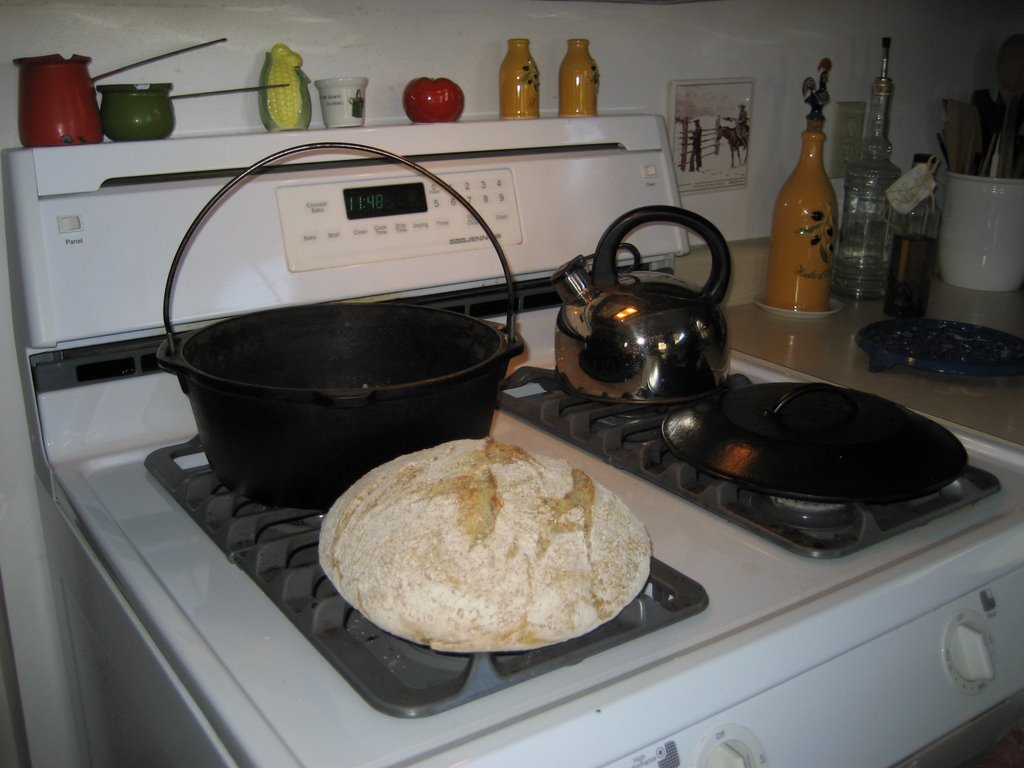
While in town for his seventy-sixth birthday earlier this month, my father made a loaf of no-knead bread. It requires very little yeast and relies instead on time (about 20 hours) to raise the dough. He's sloppy and impatient as a baker, rushing through every step to get the thing done with. When he was finished, the kitchen was covered in flour, as was he, but the result was stunning--a gorgeous golden boule, split open at the top, flowerlike, and dusted in a sprinkling of flour.

I tried to recreate the boule this weekend, and though mine is lovely enough (see photo above), it's not truly splendid. But, I'm determined to keep trying, using the very easy recipe (below) that my father saw in the New York Times last year.


NO-KNEAD BREAD
(from the New York Times as adapted from the city's Sullivan Street Bakery)

3 cups flour
1/4 tsp yeast
1-1/4 tsp salt
1-5/8 cups water (warmed in a pan, just to take off the chill, and to no more than about 120 degrees F)
flour, cornmeal, or oat bran, as needed

1. Combine flour, yeast, and salt. Add the warm water and stir until blended. The dough will be sticky and shaggy. Cover the bowl with plastic wrap and let is rest for 18 hours in a warm room. (I set the bowl on top of a towel or two and put the whole thing on top of a warm radiator.)

2. Eighteen hours later, check the dough. It is risen sufficiently when the surface is covered with small bubbles.

3. Place the dough on a lightly floured surface and sprinkle a little more flour over the dough itself. Fold it over on itself once or twice. Cover loosely with more plastic wrap, and let it sit for 15 minutes.

4. Then gently shape the dough into a ball. Coat a cotton kitchen towel with flour, cornmeal, or oat bran. Put the bread, seam side down, on the towel and dust with a little more flour, cornmeal, or bran. Cover with another towel and let the dough rise for 2 more hours.

5. Half an hour before the dough is ready, heat the oven to 450 degrees. Put a heavy covered pot (I use a cast-iron Dutch oven) in the oven as it heats. When the dough is ready, remove the pot from the oven. Turn the dough into the pot, seam side up. Shake the pot a time or two to more evenly distribute the dough. Cover with the lid and bake 30 minutes. Then carefully remove the lid (watch out for escaping steam!) and bake for another 10-15 minutes to brown the crust.

Cool on a rack. Makes excellent toast!

Thursday, December 21, 2006

WINTER SOLSTICE 2006

After a long, dry autumn and early winter, it is finally snowing. Looking out my window, I see tire tracks through the snow in the alley across from my office, and coworkers are popping in to express their excitement about the weather. We live in the Upper Midwest, where we expect to have snow on the ground, and lots of it, by Winter Solstice.

This is the time of year that marks the fourth anniversary of my mother’s suicide, and I’ve been thinking about the people who have helped me during the years after her death, often in unanticipated and surprising ways. I’m a list maker, and today I’ve made a list of those people and the various things for which I'm grateful to them.

SJG, for loving me, for doing all the housework in the months immediately afterward, and for giving me space to mourn in my own way

My sister, for listening without judgment

My father, who found just the right poems

MFO, for her letters and knowing heart

ML, who pointed me to the right stories

Ann G, who trusts in my mother’s choice

Kay, Marion, and JZ, who understand what it’s like

Jon, who gave me his copy of Kaddish

Luci, who came into this world on the heels of my mother’s departure

And Finna, for her joy.

Saturday, December 09, 2006

UNCLE LARRY’S SUGU

A young colleague, who, like me, has Italian roots, was quizzing me the other day about family recipes. She wanted to know if I had any favorite Italian recipes, and I immediately thought of my Uncle Larry stirring a giant kettle of sugu (spaghetti sauce) in his summer shorts and black knee highs. Uncle Larry is married to my father’s sister Mary, and the two of them often hosted the yearly August birthday party for my Italian grandmother, the family matriarch, now long dead. The gathering was always huge (ten adult children and their families), and Uncle Larry and Auntie Mary’s suburban home and yard accommodated everyone. It was in the basement kitchen that Uncle Larry made his famous sugu and served all the other fixings of an Italian lunch—spicey olive salad, spaghetti, warm loaves of sesame-seed encrusted Italian bread, and every kind of Italian cookie you could think of.

Lunch was buffet style, with Uncle Larry smiling his giant toothy smile as he ladled the thick sugu over each guest’s plate of spaghetti. Only recently did I receive a copy of his recipe, which serves 30 people, so do your math if you want to make less!


UNCLE LARRY’S SUGU*

2 lbs ground chuck
2 lbs mild Italian sausage
½ cup olive oil
1 large onion, chopped
Several cloves garlic, chopped
3 28-ounce cans crushed tomatoes
1 quart tomato sauce
1 6-ounce can tomato paste
½ tsp pepper
1 tsp salt
1 TB sugar
2 TB dried basil
1-1/4 cups white vermouth
1-1/2 cups chopped parsley
½ pound mushrooms, chopped

1. Saute the meat in an 8-quart kettle until cooked through.
2. Drain grease and set meat aside.
3. In the same pan, sauté the onion and garlic in olive oil until translucent.
4. Stir in the crushed tomatoes, tomato sauce, and tomato paste.
5. Bring to a boil, then add the spices, vermouth, parsley, mushrooms, and meat.
6. Simmer for 2 hours, stirring occasionally. Serve over the pasta of your choice.

Makes 7 quarts
Serves 30

*For a spicier sauce, use hot Italian sausage and more garlic, pepper, and basil, to your liking

Sunday, November 26, 2006

LUSTING IN TENNESSEE

Earlier this month, right after the hard drive on my home computer crashed, I went to Nashville, Tennessee, for a conference. Afterwards, my father joined me for a weekend to visit some of the area’s Civil War battlefields. That Saturday night, we headed into downtown Nashville for the early show of the Grand Ol’ Opry, where it crossed my mind that Garrison Keillor must have had this in mind when he created his long-enduring “Prairie Home Companion” radio show. (And indeed he had, as confirmed in an interview I happened across shortly after returning home.)

One of the battlefields we visited—Chickamauga—is in northern Georgia, just across the Tennessee border. Driving from Nashville through the colors of the forested borderland mountains took me back to southeastern Missouri, where we picked persimmons with my mother's parents in a similar vista one long ago Thanksgiving. The Civil War battlefields breathe history too, though I found myself seduced instead by the omnipresent Baptist billboards announcing all manner of saving grace and redemption. One church offered a Seven Deadly Sins weekly series from its pulpit. The sin of this, Week Three: “Avoid the Lure of Lust!”

Regional linguistic flair is enchanting, and this euphonic admonishment stayed with me all day and through dinner, where our waitress insisted we sample the restaurant’s famous bread pudding slathered with Jack Daniels whiskey sauce. Not normally enamored of bread pudding, I chose a different dessert, but the sighs of pleasure from my father were too much to ignore. One bite convinced me. Impossible to avoid the lure of this lusty bread pudding!

Below are approximate recipes for the pudding and a sauce, adapted from the waitress’s orally rendered version, from Betty Crocker, and from a must-have regional desserts cookbook by Richard Sax called
Classic Home Desserts (Chapters Publishing, 1994). Unlike many recipes for bread pudding, the pudding that lured us in Nashville relies on day-old sweet rolls instead of bread as the base. You can easily double the pudding and sauce recipes if you want a larger amount.

BREAD PUDDING

4 cups cubed day-old sweet rolls, sugar doughnuts, croissants, and/or raisin bread
1-1/2 cups milk
1 cup heavy cream
4 eggs
½ cup brown sugar
½ cup white sugar
¾ teaspoon ground cinnamon
1 tablespoon vanilla
¼ teaspoon salt

1) Put the cubed sweet rolls in an 8 x 8 pan and set aside. Heat the milk and cream in a large saucepan until hot.
2) In a large bowl, combine the eggs, sugars, cinnamon, vanilla, and salt. Slowly whisk in the hot milk.
3) Pour the hot egg-milk mixture over the sweet rolls and let stand for 15-20 minutes to allow the rolls to absorb the liquid.
4) Meanwhile, preheat the oven to 350 degrees. Bake the pudding until the custard is set but not too dry (about 40 minutes). Make the whiskey sauce while the pudding is cooling outside the oven.

Serves about 6 people.


WHISKEY SAUCE*

½ cup sugar
1 egg
½ cup unsalted butter, melted
¼ cup whiskey (Jack Daniels is the whiskey of choice in Nashville, where this whiskey is made; you can use any whiskey or bourbon to your liking)

1) Whisk the sugar and egg together in a double boiler until warm and a little fluffy.
2) Whisk in the melted butter and add the whiskey. Pour the warm sauce over servings of warm bread pudding.

*If this recipe doesn’t appeal, you can also make a classic hard sauce and add whiskey or bourbon to that recipe. Or, you can make crème anglaise and flavor it with bourbon or whiskey. Any such butter-based sauce will be excellent over the pudding.

Friday, October 20, 2006

MORNING'S MINION

Earlier this month, SJG and I watched migrating hawks in Duluth. With the lake in the distance and yellow gold trees in fall vestment below, we admired the birds floating past the overlook on columns of air known as thermals. Volunteers at the site let me hold, barefisted, a female sharp-shinned hawk. I stroked the back of her neck, leaning close to smell her. As the winds picked up, she squirmed in my hand, eager to be released to her journey south toward warmer climes. I opened my fist and, barely breathing, watched her dip toward the ground, spread her wings in wide embrace, and move skyward into the sun on large wingstrokes.

I told my sister about this hawk, and she pointed toward the first stanza of "The Windhover," a poem by Gerard Manley Hopkins:


I caught this morning morning's minion, kingdom
of daylight's dauphin, dapple-dawn-drawn
Falcon, in his riding
Of the rolling level underneath him steady air,
and striding
High there, how he rung upon the rein of a wimpling wing
In his ecstasy! then off, off forth on swing,
As a skate's heel sweeps smooth on a bow-bend:
the hurl and gliding
Rebuffed the big wind. My heart in hiding
Stirred for a bird, -- the achieve of, the mastery
of the thing!

Wednesday, September 13, 2006


PEACH JAM
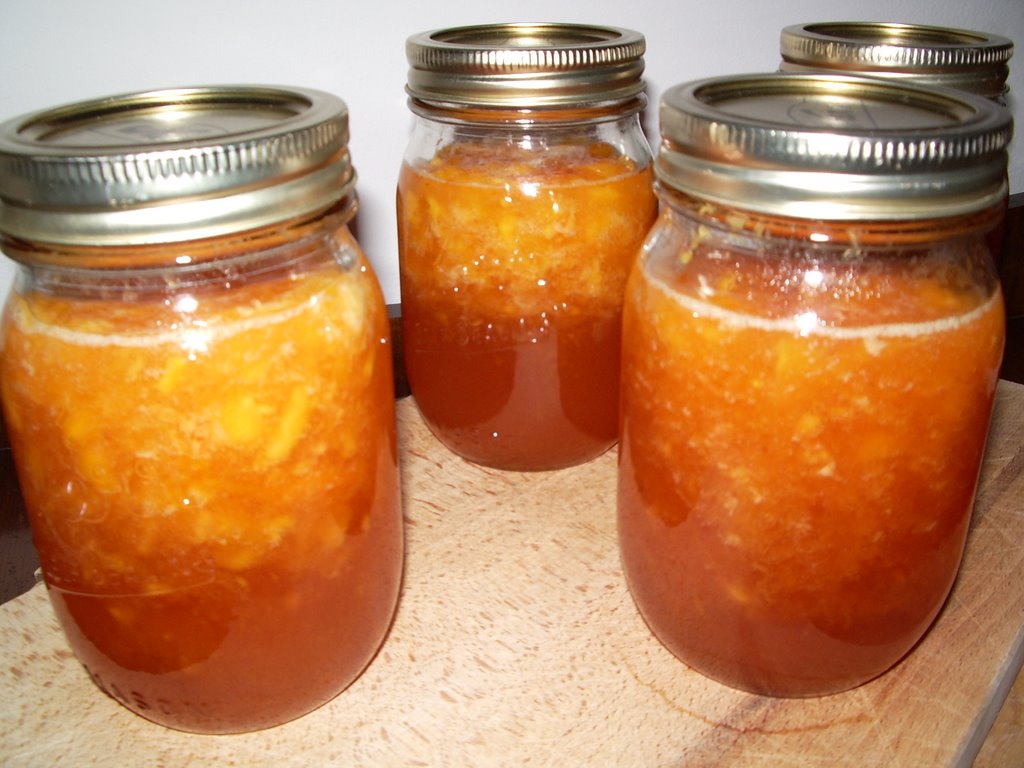
Every summer when we're doing just about nothing in the North Woods, SJG comes up with exactly one culinary challenge for our doing just about everything life. This year, she said, "Let's make peach jam." We've canned pickles, stewed tomatoes, harvest mix (stewed tomatoes, peppers, and garlic), and cranberry chutney, but never jam. So last weekend, we went to our favorite cooperative grocery to buy peaches and pectin to do just that. The next afternoon, a cool drizzly Sunday, we put up four pints of peach jam (above), as lovely in its amber glow as it is sweet and delicate on the tongue. Below is a recipe cobbled together from a variety of sources. Follow instructions carefully and make only one small batch at a time. (Note that peach season is pretty much over, though the jam will be very tasty with less than perfect fruit.)
Peach Jam
3 pounds fresh peaches, peeled and pitted
2 tablespoons lemon juice
1 packet pectin
5 cups white sugar
canning equipment (pint jars and screwtop lids and rings; kettles for cooking the peaches and sterilizing the jars; a metal canning ring for processing the jars after they've been filled; a plastic funnel; a ladle; tongs; a cooking fork; a rubber spatula)
1. Sterilize four or five pint jars in the dishwasher and leave them there until ready to use.
2. At the same time, set a large canning kettle full of water on the stove and bring to a boil. Bring a smaller kettle (8 quarts) of water to boil at the same time.
3. When the smaller kettle of water comes to a boil, set it in the sink and add the peaches. Let them sit in the water for a minute or two, then remove them, and while still warm, pull of the skins. It should slide right off.
4. Take out the pit of each peach and any brown or otherwise blemished sections. Remove the tough red fibers around the pits. Slice the peaches into chunks and place them in a large saucepan or 8-quart kettle. Mash the peaches with a potato masher, leaving some small chunks for texture. Add the lemon juice to the peaches and stir briefly.
5. Meanwhile, bring a small saucepan of water to a simmer and place the screwtop lids and rings in the water to allow them to sterilize while you're making the jam. The water in the large canning kettle should be boiling by now; place the pint jars in the boiling water and keep them there until ready to fill.
6. Add the pectin powder to the peaches and stir until dissolved over medium-high heat. Bring to a boil and add the sugar, stirring constantly.
7. Continuing to stir, bring the mixture to a full boil and allow to boil at a rolling boil for one minute.
8. Remove from the heat and skim off any foam with a slotted spoon.
9. Use a ladle to spoon the hot peach jam through a canning funnel into the sterilized pint jars, one at a time, leaving about 1/4- to 1/2-inch space between the top of the jam and the top of the rim of each jar. Use a rubber spatula to press out any air bubbles. Place a sterilized lid on top of the jar after you've filled it and carefully screw the accompanying ring onto the jar until finger tight.
10. When the jars are filled and capped, place them in the large canning kettle of boiling water, cover it, and boil for 10 minutes exactly. This helps prevent spoilage.
11. When the 10 minutes are up, turn off the heat and remove the cover of the canning kettle. When the water is no longer boiling and bubbles are no longer rising to the top (about three minutes), processing is complete.
12. Remove the jars with a pair of canning tongs and set them upright to cool and set undisturbed for 24 hours.
13. The next day, place the jars somewhere cool and dark for storage. Best eaten within the first six or eight months, after which time the jam will begin to darken and get runny.
* for extremely helpful tips, photos, recipes, and other useful information about canning, go to www.pickyourown.org

Friday, September 08, 2006


EIGHTY-ONE...AND DRUMMING
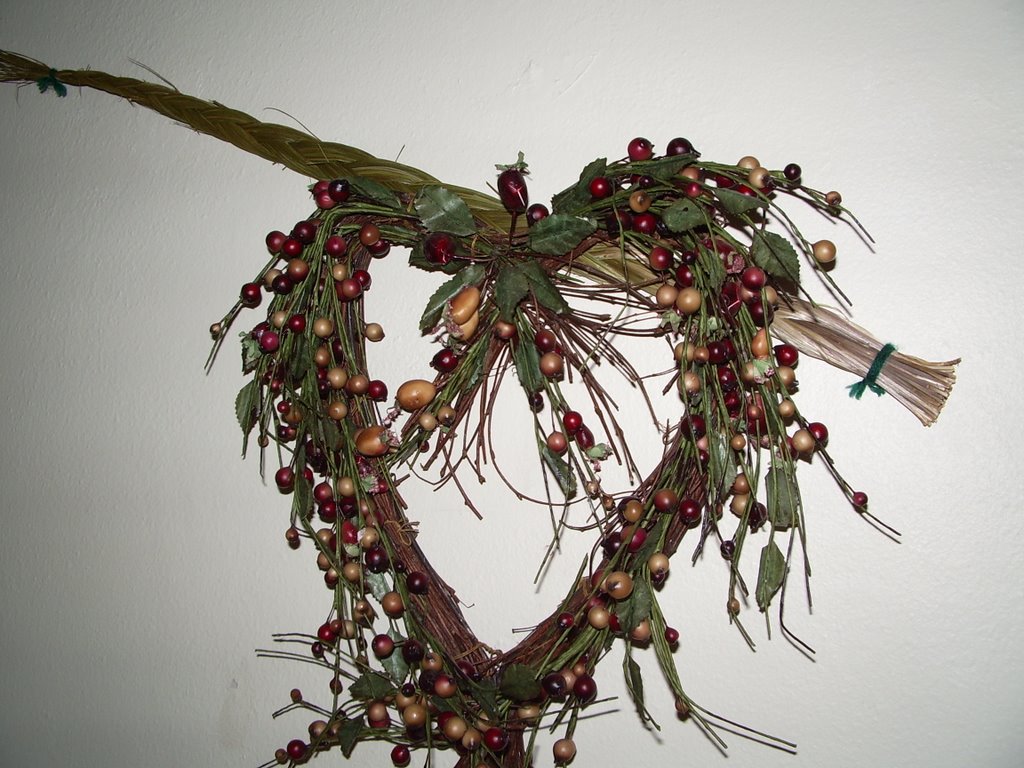
On behalf of my sister, I brought a length of braided sweetgrass to my Aunt V. in Milwaukee this past holiday weekend. For now, she's enlaced it with a heart of grapevine stems and berries (above) on her living room wall, but once it dries, V. will use the sweetgrass for smudging at drumming circles, which she hosts in her backyard. She and the women with whom she drums tie red prayer cloths around the slim trunk of the crabapple tree V. planted in memory of her older sister (my aunt) C., who died three years ago. The drummers invoke their higher spirits and say a prayer of honor and thanks before smudging the tree and the sacred circle around it in which they will drum. They learn rhythms together and then turn to silent meditation to the beat of their drums.
I came to know my Aunt V., who last month celebrated her eighty-first birthday, when I was about fourteen years old and she was the age I am now. My parents dropped off the three of us--my sister, my brother, and me--to spend a week with her (she is one of my father's older sisters) and our Uncle G. in the small house they shared with G's two older brothers and a large dalmatian. My parents were headed to an august medical facility many hours away where my mother underwent a battery of tests, which eventually ruled out cancer and determined her to be in robust physical health.
In those years, my aunt and uncle led a very private life, and in retrospect, I see that, in welcoming three children whom they barely knew--two teens and a three year old--my relatives had said yes to an intrusion into their privacy, and to a lot of work. As mistress of the house, V. kept us occupied all day and every day with activities we thought she undertook on a lark but that must have required much forethought, planning, and organization.
That summer, we learned to sew with Vogue patterns and to make pasta by hand, stringing lengths of hand-cut fettucine to dry on hangers before cooking. At some level, we recognized our aunt's efforts, for on her birthday, which arrived during our visit, we proclaimed her Queen for the Day. To start the morning, we served apricot sugar toast and coffee to her in bed and executed an ambitious dinner that evening, an undertaking that proved the wisdom of avoiding the temptation to prepare a new recipe as the centerpiece of a special meal. In tackling salmon croquettes, I discovered, too late, the difficulty of replicating neatly shaped and perfectly browned patties as displayed in lustrous glory in the pages of V's Bon Appetit magazine. No matter the meal's imperfections, the memory is one we still recall fondly, and the visit cemented a relationship that has endured for more than thirty years.
In remembering that week with her, and in learning more about her drumming this last visit, I admire more than ever V's willingness--and ability--to choose yes as a response to life, even when many and sometimes most of the variables are unknown. It's impossible for me to avoid contrasting her, now long widowed, with my mother who, though fearless in her imaginative life, was, unlike V., largely overwhelmed by the physical, tangible realities that come with being human. I hope I'm not deluded in imagining my own life as some mix of the best of the two approaches, and I like to envision that when I'm eighty-one, I'll still be saying yes to life and finding sacred possibilities in my own backyard.

Thursday, August 24, 2006

SUMMER BERRIES

For the last couple years, we’ve been stopping in Duluth for lunch on our way to the North Woods. This harbor city, which we used to whiz past, is becoming known for independent-minded restauranteurs with a desire to serve simple yet delicious food from seasonal, locally produced ingredients. We ate lunch this year at the Nokomis Restaurant & Bar (www.nokomisonthelake.com) on the scenic stretch of old highway 61 just outside of town. The restaurant occupies what was once a lakeside supper club, and with its large plate-glass windows offers a spectacular view of Lake Superior just across the road.

We started our lunch with a salad of field greens encircled with a long strip of thinly sliced cucumber and topped with roasted tomatoes, thin slices of radishes, white enoki mushrooms, roasted pumpkin seeds, and Maytag blue cheese dressing. For the entrĂ©e, SJG chose a hamburger of grass-fed beef and shredded short ribs on toasted focaccia. I opted for vegetarian fare: slices of toasted ciabatta spread with black olive tapenade and layered with fresh basil, slices of red and yellow tomatoes, and quenelles of ricotta. SJG raved about the molten chocolate cake she chose for dessert, while my warm blackberry-raspberry cobbler brought back memories of my Missouri grandmother’s recipe for a blackberry dessert that was part-cobbler, part-crisp, part-buckle—a recipe I’ve never seen replicated in any cookbook. Below is an approximation of that summer berry recipe.

Missouri Ozarks Blackberry Cobbler

Berries:
1-1/2 pints blackberries
1/3 cup sugar
3 TB cold water

Topping:
6 TB unsalted butter (room temperature)
½ cup sugar
Pinch of salt
½ cup flour
½ cup old-fashioned pearl tapioca
Ground cinnamon (optional)

1) Preheat the oven to 350 degrees F. Place the berries in a 9 x 13 baking dish. Sprinkle with the sugar and pour in the water, combing gently with your fingers.
2) Cream the butter, sugar, and salt. Stir in the flour, tapioca, and cinnamon (if using).
3) Sprinkle the topping over the berries. (If you like a lot of topping, as I do, feel free to make more of it. This is up to the individual palate, though it may prolong baking a little.)
4) Bake until done (roughly 20 minutes; check frequently just to be sure).
5) Cool briefly, and serve warm with vanilla ice cream.

Sunday, August 20, 2006

THE NORTH WOODS

Set on the edge of a lake in the northern wilderness, a much-loved cabin is the place we go every summer to recuperate from the year’s frenzy. We bring pillows, our favorite pajamas and fleece socks, piles of books and periodicals, and, above all else, the determination to avoid the urge to do.

This year is no exception. On the long drive north, we discuss whether or not we’ll take naps like we did the year the temperature soared into the nineties every day. At a minimum, we agree, we’ll be certain to put in twelve-hour nights, heading to bed as soon as the sun slips behind the ridge of pines to the west, leaving a rosy glow behind the canopy.

We arrive late, unpack and settle in quickly, and take a brief walk with the resident dog. Then we head to bed, adding a feather quilt to the pile of blankets and opening the windows to let in the pine-scented air. It’s very dark here, with no glow of city lights or flickering of the neighbors’ motion-detector floodlamps, and as we settle under the covers, darkness calls forth the silence of the place. It’s a still night, with no breeze to filter through the leaves, and we lie still, breathing as quietly as possible, listening for any noise that might break the spell.

The silence is stubborn, and though we anticipate a bird’s call or the crunch of a neighbor’s footstep on the gravel pathway, we hear nothing. Tired from the long day’s drive, and eager to stay true to our pledge, we drift to sleep as the three-quarter moon rises high in the black sky above.

Sunday, August 06, 2006

SUMMER ICE CREAM
Every summer for the last several years, my father and I have made ice cream using the electric ice-cream machine he and my mother bought years ago. One summer they made ice cream every week from whatever fruit was in season at the moment. Their peach ice cream stands out, smooth and delicately flavored, tasting almost exactly like the scent of the fruit itself. This year, my father and I made vanilla lavender ice cream with goats' milk as the dairy base. It brought back memories of the long-ago peach ice cream with its special satisfaction of merging senses.

Vanilla Lavender Ice Cream
Lavender Milk:
1 cup goats' milk
6-8 sprigs fresh lavender

Put the milk and the lavender in a small saucepan over medium heat. Just before it starts boiling, remove from heat, cover, and allow to infuse for 20 minutes. Strain the milk into a small bowl, discard the lavender, and let milk cool for another 10 minutes.

Ice Cream:
6 egg yolks
1 cup sugar
3 cups goats' milk (or, half goats' milk/half cows' milk)
lavender milk (see above)
1 cup whipping cream
1 vanilla bean (or 2 teaspoons vanilla extract)

1) Put the egg yolks and sugar in a big saucepan. Beat with a whisk until pale yellow.
2) Put 3 cups goats' milk and lavendar milk in another saucepan. Cut the vanilla bean in half and gently split each half open and add to the milk. Slowly bring just to the boil.
3) Add about 1/2 cup of the warm milk to the egg yolk and sugar mixture, beating constantly. Stir in the remaining milk. Scrape the seeds from the vanilla bean into the custard. Stirring the whole time, slowly bring the mixture again just to the boil, at which point it will be smooth and custardlike. (Just under the boil is 180 degrees F, which assures the safety of eating the eggs.)
4) Pour the custard into a chilled bowl and allow to come to room temperature. If a vanilla bean was not used, stir in the vanilla extract. Then place the custard in the freezer for about 30 minutes to make for faster churning.
5) When ready to churn the custard mixture, whip the whipping cream until just under stiff-peak stage and fold into chilled mixture. (This makes for more volume.) Pour the mixture into an ice cream maker and churn according to manufacturer's directions. Chill in freezer for several hours before serving. Makes about 1 quart of ice cream.

Friday, August 04, 2006


MATERNAL BODIES

Our neighbors, Peter and Gaye, have two little girls aged nine and three. The other day, Gaye and the girls were in their backyard, and as the four of us talked, the girls climbed and slid across their mother's body as she lounged on the grass. Into my mind sprang the memory of this feline mother and her offspring, who, like Gaye, lay patiently in grasses on another continent while her cubs claimed the maternal body as their own.

Monday, July 31, 2006

AMERICAN FORMATIVE VALUES: WEAVING THE AMERICAN FABRIC

My sister went to the new downtown public library recently to hear historian Neil Baldwin talk about his book The American Revelation: Ten Ideals that Shaped Our Country from Puritans to the Cold War, which was released this summer in paperback. Not particularly inspired by Baldwin himself, she was, however, deeply intrigued by the idea of pinpointing characteristic American values that shape our common personality, so when my father came to town for a visit last weekend, we agreed on that Friday to craft our own lists and to come together on Sunday afternoon to share our thoughts about the American personality. The four of us (my father, my sister, SJG, and I) sat on the back porch all Sunday afternoon, quizzing each other in detail about our lists, amplifying ideas, making connections to other related theories—all at top volume and with much manic waving of napkins and leaping about to make an emphatic point.

After hours of conversation, we had shaped a seven-page list, out of which we pulled the following top-five values, which we agreed, as a group, to be characteristic of the iconic American personality. Caveat: these are idealistic values, which, though brilliant in their allure, sometimes manifest darkly and are not experienced by all of the people all of the time. However, they are values to which this particular group feels we aspire as a nation and which we feel do distinguish us as a people from other nations and cultures in other parts of the world.

1) Individualism—the notion, inscribed in our Declaration of Independence, that each individual has certain “unalienable rights,” and that each person has the right to live up to one’s abilities and interests, as defined by self. As Americans, the tension between acting for the greater common good and “doing your own thing” generally plays out in favor of individual choice.

2) Pragmatism—the tendency to figure out a problem based on what works at any given moment rather than relying on pre-established, accepted truth; a sort of “If at first you don’t succeed, try, try again” approach to life; pragmatism as a school of philosophical thought was pioneered in the nineteenth century by American philosophers John Dewey, Charles Sanders Peirce, and William James (brother of Henry James). Generally speaking, they held that experimentation, inquiry, and observation are the tools for determining “truth,” with complete freedom to re-determine and re-name any of the objects under investigation at any time.

3) Mobility—the general openness of American economic, political, and social systems, whereby individuals have ease of movement among and between groups or places. To be born in one class, in one place, among one set of people does not mean one spends an entire lifetime in that same class, place, or set of people. This plays out in a general flexibility of thought and practice—the ability of the average American to go beyond prescribed limits to see if something is doable or enjoyable. Want to paint your house purple? Go for it! Want to have salmon with chocolate (a definite no-no in French cuisine)? Why not!

4) Fusion—the ability and desire to incorporate cultural expressions of all stripes into the mainstream or to simply accommodate them alongside other options, whether it be music (blues influence in jazz, country influence in rock and roll), food (Cuban Chinese restaurants), vocabulary (street language or foreign terms that become part of everyday mainstream vernacular), or ethnic family groupings (Chinese Jewish families as one example). Our socio-cultural fabric is like a sponge--very absorptive.

5) Optimism—a “things are looking up” approach to life, whereby events are perceived to flow inevitably toward the good, the better, the best. We came up with a list of classic popular songs, such as “High Hopes” and “Accentuate the Positive,” that speak to this American tendency to avoid bad news and to express a distinct preference for "the sunny side of the street."

Try making your own list—see what you come up with!

Saturday, July 08, 2006

BOTSWANA MASALA

Southern Africa is home to an intriguing mix of peoples. That part of the world often telescopes into a black-and-white paradigm, but the blend is much richer, with populations of black, white, yellow, brown and everything in between. As a result, the cuisine is varied. On safari in Botswana last month, I mentioned my interest in local foods to the camp manager's wife, a lovely young woman with family roots in subcontinental India. So one evening, she arranged for us to be served a traditional meal of eland stew--cooked slowly on top of the camp stove all day to release the meat's juices and marrow--with mounds of steaming-hot, white polenta as the accompanying dish.

People in Botswana generally eat fruit for dessert, if they have dessert at all. But since the safari camps cater to American tastes, we savored a rich, dense gingerbread cake for dessert that evening. Alongside our plates, the servers placed small white pitchers of warm "pudding," or creme anglaise, to pour over the cake. Ginger is a common spice in Botswana, used both in African dishes as well as in those brought to the continent by its Indian population. In memory of that meal is this easy-to-make version of gingerbread cake.

Gingerbread Cake

3/4 cup dark honey
3/4 cup vegetable oil
1 cup unsulphured blackstrap molasses
3 eggs
3 cups sifted flour (half white, half whole wheat)
1 teaspoon salt
3 teaspoons baking powder
1-1/2 teaspoons powdered cloves
1 teaspoon ground ginger
1-1/2 teaspoons cinnamon
2 cups buttermilk

Mix honey, oil, molasses, and eggs in a large bowl. Sift together all the dry ingredients in a separate bowl. Add the flour mixture to the honey mixture alternately with the buttermilk. Pour the batter into a greased 9 x 13 pan. Bake at 350 degrees for 35-40 minutes. Serve slightly warm with whipped cream, flavored to taste with sugar and vanilla.

Friday, June 30, 2006


BELOW THE SURFACE

Polite smiles, yeses and nos, perhaps a few words in answer to the usual questions. Is it hot here in summer? How many cubs does a lioness birth? Where does your family live? I want more. Do you have siblings? How many? What does your name mean? Not your English name, the one for white foreigners. Your real name, the one that links you to this place. It means “not the same way.” He, our guide, is the youngest child. Seven of the eleven adult siblings are dead. They were sick, he says, when I ask how. In naming him, his mother wards off the sickness. This child will not be taken from her like the others.

We stop talking, still in our tracks, like the impala we pass each day. Alert to danger, to realities that keep us apart. Read about in books, perhaps, or gleaned from other inquisitive questionings.

The silence lingers, overtakes us. The relationship—between guide and tourist, man and woman, black and white—has no words to touch his sorrow. Yet in parting, the young guide steps toward me, leans forward with open arms. I move into his embrace, unanticipated, generous, as innocent, I think, as my questions had been. Between us, a vast landscape of human experience remains untouched. Where words can’t go, a gesture of affection has taken us below the surface, to the region where understanding lies and where hope burns. I climb into the tiny aircraft that will take me to the next camp, wiggle my fingers in farewell through the crack of the open window, and train my eyes on the waving arms below until all human form blends into the dun colors and broad sweep of the bush.

Sunday, June 25, 2006


INTIMATIONS OF MORNING

Coming to wakefulness from sleep, I open my eyes. The blackness is complete, oddly rich, not unlike the smooth sheen of melted chocolate. I wonder for a moment if blindness has this same sensual depth. I lie quietly, anticipating the shapes of things to announce themselves, even if only in shadowy outline. But nothing emerges at all, only the sounds of the bush outside.

Baboons have begun to bark, the leaves of the trees rustling as the animals make their way through the branches above our tent. A lion roars, rumbling and low, in the not-too-far-away distance. The delicate chiming of bell frogs slowly diminishes, overtaken by hornbills sounding in raucous staccato. Slats of soft light reveal the framed outline of the tent windows, netted and thickly curtained to hold back the chill of night. I can pick out familiar shapes now, folds of mosquito netting around the bed, a chair in the far corner, the woven screen that encloses shower, sink, and bath. Fruit bats, calling forth evening darkness in clinking gate-latch chorus, end their song as the light shifts, rose-pink embers’ glow.

I slip out of bed, slide open the doors of the tent, and step out onto the verandah. The veld spreads before me, vast, quiet, secret. Palm trees stand tall along the distant horizon, delineating land from endless sky, and in between their dark trunks, a small orb rises, silently, swiftly, to paint the sky blood orange red.