Monday, March 20, 2006


FEELING NOSTALGIC
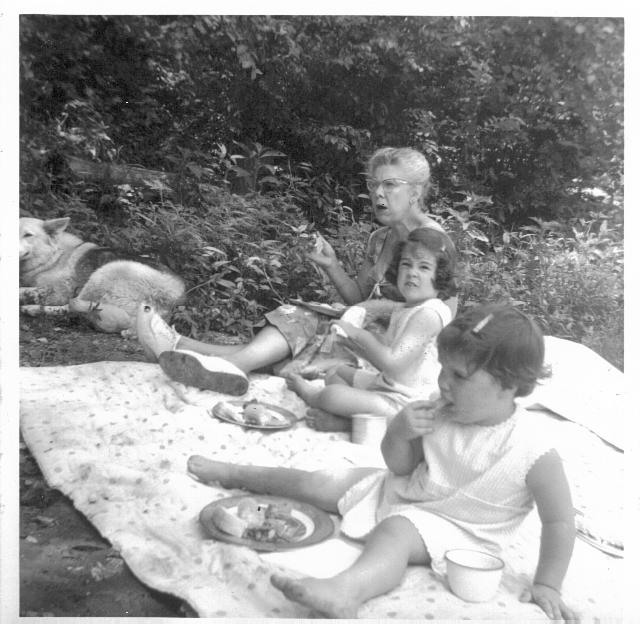
(Piney River picnic, left, 1963)

My sister is in London until Friday. She left her computer at home and took paper and pen instead, saying she wanted to be in London the way it once would have been, free of instant messaging and satellite phone connection. I'm not supposed to call or email. I've resisted the phone call, but, of course, I've already sent her three emails, which she doesn't seem to have read, so I guess she's staying true to her vow.

With the edicts in place, it's awfully quiet around here. When my sister is at home, we talk all the time, either by phone, email, or in person. When I run out of things to say, she keeps right on going, and I say, "Uh, huh or "uh, uh" in reply, just like when we were young. I got to feeling nostalgic this morning and dug around in a closet for the white photo album where the old family photos are. I was looking for a particular image of my sister and me sitting in a pile of leaves on the curb in front of one of the Columbia, Missouri, homes. Instead, I found this picture from a 1963 picnic on the Piney River with my mother's mother (seated, background), my sister (foreground), me (in the middle), our shepherd Leki, my parents (off frame), and my mother's Aunt Maud and Uncle Willis (also off frame). It brought back fond memories of that river, where we searched for crawfish, skipped rocks, and collected buckeyes.

One summer, years after the 1963 picnic, my grandmother took my brother and me for a picnic on the Piney. She sat on the rocky riverbank to lay out our lunch while my brother and I, teenagers both, stripped off our clothes and lept off a boulder into the deep and dark waters below. My grandmother, a very proper grande dame indeed, looked up and smiled. "My little frogs," she said.

Wednesday, February 22, 2006

THE FAINTING

In searching for a gardening essay I'd written a couple years ago, I ran across a piece about family communications that I'd written a long time ago. It was funny then, and it's still funny now.

Donna said she'd heard about The Fainting from her sister, Rose, who'd heard about from their brother, Dan, who'd heard about it from their father, Dominic. News gets around like that in that family. The source of family information is always several people back. No one ever seems to remember exactly who the original source is, and I doubt anyone really cares. The most important thing just seems to be the news.

There was the time their mother, Virginia, moved back into the house on Peters Square with Dominic. I think that news came from Rose, who'd heard it from Virginia, who'd actually been invited by Dominic. Donna was surprised by that one. After all, only twelve years had passed since Virginia and Dominic's divorce--and Dominic holds a grudge. His most recent outburst had been the threat of police action if Virginia ever stepped foot on his property. But, maybe twelve years is, after all, long enough to erase--or at least to dull--the sharpness of bitter memory. Donna said maybe it was loneliness. Or old age. But most probably, it had something to do with eating habits.

Virginia liked to test already-proven formulas, and the Greenway housing coop experience was no exception. She left Omaha in a hurry, speeding back to Minneapolis, her mother's old black Buick crammed full of belongings, the typing table and captain's chair firmly strapped to the top. Rose went with her for the ride. Donna says it was for the money--Virginia paid Rose to miss work at the library.

Rose didn't stay in Minneapolis for long, but Virginia did. She moved into the Greenway coop, into the room where Fran had lived when Rose was there. Actually, Rose moved in after Fran did. Fran had greeted Rose at the front door in her dirty long johns and ill-fitting robe. Fran's mother had given the robe to her at Christmas. Fran wore it out of guilt, or perhaps in the false belief that love had guided her mother's choice.

Shortly after the move, Donna went to visit Virginia in her new room at the Greenway. All the treasures that had been stuffed and wedged into the old black Buick were there, neatly arranged around the room. A few new postcards were tacked up onto the freshly painted walls, and handstitched quilts had been rolled onto wooden dowels to serve as curtains. Donna said Virginia could turn a storm sewer into a home.

Donna and Virginia ate breakfast out near the high school that morning. Virginia picked at an omelette--she always had a nervous stomach--and Donna slammed her thumb in the doorjam of the stall in the women's bathroom. She lost part of her nail, but Virginia still made her pay for the meal.

Donna says that Virginia's parting gesture after breakfast was a finger up the nose. Typical, and mostly in fun, but partly serious. Donna and Dan and Dominic had plans for dinner together that evening, and Virginia--as always--felt left out. Dan said she'd been talking a lot about marriage recently, mostly because she wanted a color television. And a good meal or two, which is how it all started, really.

A few months later, Donna called Dominic, who told her that Dan had told him that Virginia had reported that she'd fainted at work. The doctor attributed the fainting to poor eating habits. Dominic and Dan swore it was the strictly enforced vegetarian menu at the Greenway coop. Donna said it was more like a lifetime of cigarettes, coffee, Coca-Cola, and a five-pound bag of sugar every week. No one could agree on the cause exactly, but four weeks after The Fainting, Virginia showed up at Dominic's door, was invited in, fell asleep on the couch, and hasn't left yet. At least that's what Donna says she heard from Rose, who heard it from Dan, who heard it from Dominic. And he should know.

Tuesday, February 21, 2006


WINTER BLOOMS
(flowering cattleya, left)
My cattleya is in bloom. It hasn't produced flowers since I bought it several years ago, inspired by a visit SJG and I took to an orchid garden on a wintertime trip to Key West. When I bought the cattleya, the plant was in full bloom. But after the flowers faded and dropped off about a month later, it didn't produce a single bud or bloom again. I followed all the greenhouse directions--occasional on-schedule feedings, regular waterings and spraying with distilled water, perfect placement in an east-facing window with sheer curtains to filter the morning light during winter, and an under-the-trees outdoor life during the summer when natural rains could feed it. With no results.
I seriously thought about throwing it out. My mother, who had a magical green thumb, grew orchids with my father when I was young. They built a basement greenhouse, where they kept many different orchid varieties, bringing them into the dining room as they came into bloom at different times. When a plant gave up its annual blooming life after several years, they threw it out and replaced it with another orchid. But I couldn't bring myself to throw out my cattleya. Even though it wasn't producing flowers, it was still alive, and I couldn't bear the vision of trash can suffocation. Instead I moved it all over the house, including into the basement for a couple of winters, where even there it refused to give up.
Earlier this month, my sister casually mentioned a Swedish friend's wife, who grows orchids--in Sweden of all places. It's cold and dark there, yet this woman's orchids are blooming profusely now under what is described to me as neglectful care. I decided to try a version of managed neglect. I brought my cattleya from the basement and into the bathroom, where I placed it on the floor near the radiator and away from the windows. I figured the room's humidity and indirect light would bring miracles. If my approach didn't work, I promised myself, I would finally throw out the orchid.
But it did work, and the cattleya has been in bloom for about a week, with another four or five weeks to go. I think I'll bring the cymbidium into the bathroom tomorrow.

Friday, February 17, 2006


SWIMMING TO SERENITY

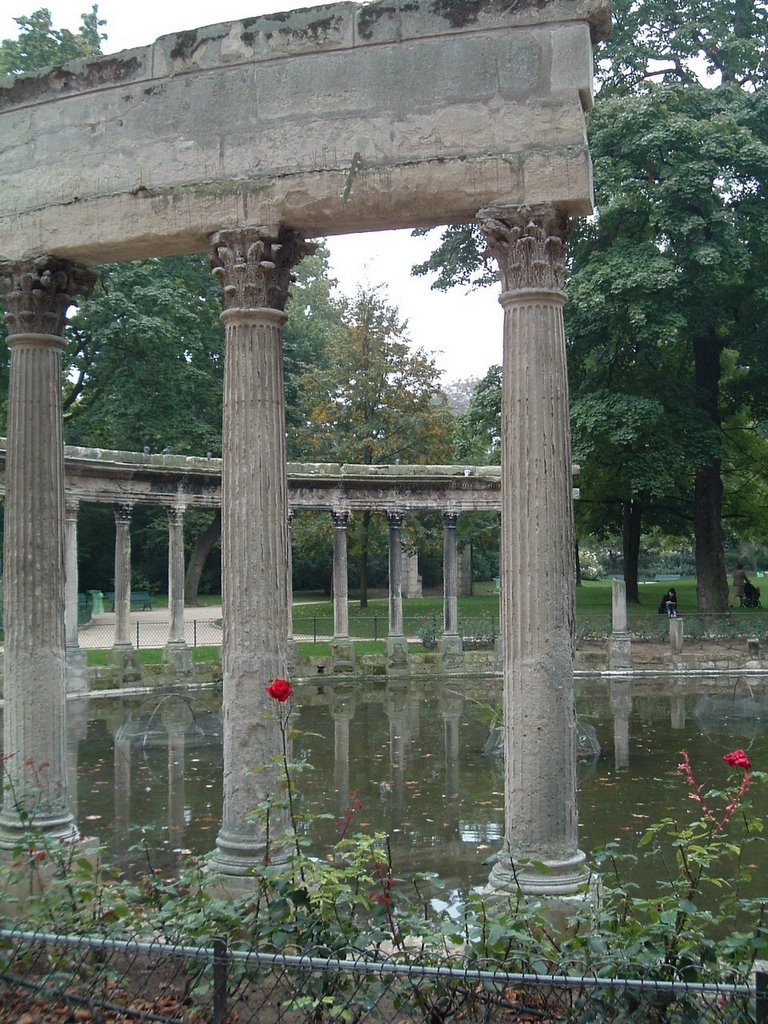
(Photo at left of the Roman pool at the Parc Monceau in Paris, courtesy of my father)

In the winter months, after it's become too cold and icy to ride my bicycle to work every day, I change my routine of exercise to include weekly swimming sessions at the downtown pool. I usually go in the midafternoon, when the pool is quiet, and there's only me and the Eastern European ladies in their swim caps and giant floral-patterned swimsuits. One time, in the steam bath after my swim, I ran into one of the ladies drinking a clear liquid from her flask. "That's a great idea, to drink water in here," I said to her. "I'm drinking vodka," she replied, and we both chuckled.

Although swimming is an exercise for the body, I find that, for me, it's primarily an excercise in meditation. Energy slows with each exhalation into the water, moving inward with each stroke. The exterior world begins to fall away, and I listen to my breathing as the water streams past my body and flows out through my nose and mouth with each forced out-breath. I imagine it must have been like this in utero.

I've never been a fast, powerful body in the water. In fact, years ago when in graduate school, I took a thrice-weekly swimming class at the university's Olympic-sized pool. One of the surprise! goals of the class was to increase speed and power, so at the beginning of the first week of class, we buddied up and counted the number of laps we each could swim in a five-minute period. I swam 18 laps. At the end of the semester, we again buddied up and counted laps for the same amount of time. Every one else in class had increased their capabilities by a lap or two. I again swam 18 laps.

I think this means that my potential as a swimmer is what it is, and that there's something in me that doesn't want to swim fast and hard. What I do want is to hit my stride, whatever that may be on any particular day, and to view life from a water creature's perspective--with that funny feeling of solitude and extreme insularity, even with other bodies in the water. One afternoon at the university all those years ago, swimming laps in the slow lane, I rotated onto my side for an inhalation and made contact with a woman swimming over and on top of me. As I held my breath to wait for her to clear my body, I wondered why she hadn't chosen one of the fast lanes. Swimming, of course, does have a competitive side, but drowning your fellow swimmers in the slow lane seems to go beyond the pale. Feeling the power swimmer had violated some common code of water life--whereby all swimmers respect solitude and insularity--I felt frightened that day, unable to regain my meditative rhythm, and got out of the pool at the far end of my lane. I like to tell this story to the lifeguards at the downtown pool. That way, I figure they'll remember me and look out for me in case anyone else tries to overpower me in the slow lane. But no one ever has and my pool-life serenity has only that one blemish.

Monday, February 13, 2006

SHAPING EACH OTHER'S LIVES

Humans, as social creatures living in community, shape the lives of those around them. I know that in principle I've influenced the lives of people around me, loved ones and strangers alike. But it's hard to see that influence, and it's a rare event when any one of these people has actually confirmed or described to me the impressions I've made on them. If they've done so, it's usually been under unusual circumstances or in a moment of emotional fervor. I view these confirmations of human impact on other lives as a sort of footprint, proving that we have passed this way and have left certain recognizable signs in our wake.

Just this weekend, my young neighbor friend Gracie, who's almost nine, unwittingly showed me one of my footprints. SJG and I had invited Gracie, her mother and father, Gay and Peter, and her little sister, Bronte, to our house for a rib feast to celebrate Gay's birthday. We prepared the ribs the two-day way, marinating them overnight in spices, grilling them briefly the next afternoon, and finishing them in a two-hour steam bath in the oven. To please Gracie and Bronte's palate, we also made our favorite macaroni and cheese recipe; cole slaw rounded out the meal. We left the choice of dessert to Gay, and she opted for chocolate mousse. I made the mousse well in advance, to give it time to chill and set in individual glasses, with plans to serve each glass with a dollop of whipped cream and chocolate shavings.

After we'd finished the main meal, I called Gracie into the kitchen. "I need your help with the whipped cream for the mousse," I told her conspiratorially. She raced into the kitchen after me, and I handed her an old-fashioned set of beaters, the kind that you turn by hand. They fit neatly into a cylindrical ceramic container and work perfectly to beat small amounts of whipping cream and egg whites.

Gracie looked puzzled. "What are we going to do with these?" she asked.

"We'll beat the whipping cream with them and put a little spoonful on top of each person's mousse," I explained as I pointed to the small glasses of mousse in the refrigerator.

"Oh," Gracie replied. "I thought we were going to squirt the cream out of a can!"

"Nope," I replied. "We're doing the real thing." I poured the whipping cream into the ceramic container, placed the beaters on top, and told Gracie to start turning. "You can switch hands if you get tired," I explained.

Gracie dutifully began to crank the beaters, and within seconds wondered if her work was done. I showed her how to lift the beaters to check the consistency of the cream, and she went back to her work, checking frequently and switching hands as her eight-year-old arms tired. In due time, she exclaimed, "I think it must be done. It's getting really hard to turn this thing."

And indeed the cream was ready to spoon onto the mousse, after which Gracie sprinkled each one with chocolate shavings. She carefully placed the glasses of mousse onto a serving tray, carried it with great delicacy into the dining room, and placed it before her mother. "Mom, I beat the cream!" she cried with girlish pride. In a flash, I saw my footprint, saw through Gracie's excitement and pride that I had offered her a way to use her human powers to transform something ordinary into loveliness.

Tuesday, January 24, 2006

ONE THING LEADS TO ANOTHER

My sister is a writer. These last few months, she's been working on a book about Morocco. In her background reading, she ran across a lovely poetical work called Desert Divers, by Sven Lindqvist, translated from the Swedish into English by Joan Tate. Desert Divers is part travelogue, following Lindqvist's journey in the latter part of the twentieth century across North Africa, mostly in Morocco and Algeria. It's also a reflection on personal and political memory, the ways in which we supress some things, lie about others, and aggrandize the rest. What sustained my interest, though, is that he tells his story through an exploration of a handful of French writers who were drawn to the Sahara, which reaches up into North Africa, during the late 1800s and early 1900s.

One of these writers was Andre Gide, whose book L'immoraliste takes place in part in Biskra, Algeria. A novel about liberating the self from societal constraints, it's a book I remembered reading in graduate school twenty years ago. I became dissatisfied relying on Lindqvist's retelling and interpretation of Gide's desert drama, so I ran upstairs to the study to pull out my copy of the book from my lawyer grandfather's bookcases, which I've inherited from my mother. As I thumbed through the well worn copy of the book, reviewing the notes I'd scribbled to myself years ago in the margins, I was caught by this passage, which defines what it is to be an artist:

J'ai toujours cru les grands artistes ceux qui osent donner droit de beaute a des choses si naturelles qu'elles font dire apres, a qui les voit: "Comment n'avais-je pas compris jusqu'alors que cela aussi etait beau..."

In English, this more or less means:

I've always believed the great artists to be those who dare to give the right of beauty to everyday things, which lead those who see them to say afterward, "Why did I not understand before that this, too, was beautiful..."

By these standards, I think my mother was an artist. I have a vivid memory of her making toast for me one morning many years ago in her apartment. It was a lengthy process, and I marveled then, as I do now, at the way she held everything required for toast making in complete reverence--the slices of homemade bread, the toaster, the creamy butter and the knife she used to spread it with, the white Limoges plate she chose to put the toast on, the crisp linen napkin she spread across my knees. It seemed so easy and natural with her, and when I went home after that visit, I tried to replicate the experience on my own. But, without her there to promote the artistry, it wasn't possible. All these years later, I see that I have inherited something of her eye for beauty. And I try to stay true to her intuitive understanding, expressed so succinctly by a Frenchman before her, that art and artists lie right before our very eyes.

Sunday, January 22, 2006

TOO FANCY FOR THEM

Every now and again, I play cards with three former colleagues with whom I used to play cards at lunch every single workday. We would gather at the kitchen table with our sack lunches at precisely 12:30 and play for an hour. Known for too much table talk and stretching the rules wildly, we paired off and bid our tricks, screeching with glee as we trumped our competitors or caught them short a trick. One coworker, who never joined in the game , routinely complained to our supervising editor about the noise we made. Periodically, email reprimands would come our way, and we would play cards in whispers for the next few days. But invariably, the sheer fun of the game caught up with us, and we were back to our noisy antics.

This weekend, the four of us gathered for cards for the first time in about a year. We all have demanding jobs and live far from each other in the farflung corners of the metropolitan area. One of the group, who has two young children, drives in for cards from a neighboring state, where she and her husband are refurbishing an old farmhouse. She's the most serious card player among us, and loves to win. I'm always nervous when she's my partner at cards. I'm a somewhat sloppy player, no good at counting cards and prone to erring on the side of risk. She, on the other hand, knows where every card is and wins by careful calculation and cautious but accurate bidding.

The friend who hosts our card parties is very generous. She always serves lunch and rarely asks us to contribute to the feast. This time, though, we volunteered, and she suggested I bring the dessert. At first, I thought about bringing the chocolate-apple tarte I'd learned to make in Paris this fall. But SJG tells me it's on the unusual side, and these friends have conservative palates. So I decided to bring my favorite American dessert--oatmeal caramel bars. It's a recipe I begged one of my neighbors to give me. She's always reading church cookbooks and the glossy recipe booklettes at the grocery store check-out counter. A steady flow of marshmallow bars, bakeless pies, and cookies with every chip imaginable come our way from her, and the oatmeal caramel bars are my favorites.

Over lunch, as we talk about my culinary trip to Paris, my card-playing friends compliment my blog but agree that all the recipes were way too fancy for them. "I didn't even know what half the words meant!" says the serious card player. We laugh, and I think of my paternal Aunt Lina, who said the same thing. I'm glad I brought the bars. They're a hit, and this time, I'm on the winning team at cards.

OATMEAL CARAMEL BARS
3/4 cup butter, melted
3/4 cup brown sugar
1/4 tsp salt
1/2 tsp baking soda
1 cup flour
1 cup finely cut oatmeal
32 caramels
5 tablespoons cream or millk
1 cup chocolate chips
1/2 chopped nuts (I like pecans)

1) In a mixing bowl, combine the butter, brown sugar, salt, baking soda, flour and oatmeal. Stir until butter is absorbed.

2) Pat about 3/4 of the mixture in the bottom of a 9 x 13 baking dish and bake for 10 minutes at 350 degrees.

3) Meanwhile, melt the caramels and the cream.

4) Sprinkle the chocolate chips and the nuts on top of the oatmeal base. Cover with the melted caramels and then the rest of the oatmeal mixture. Bake 20 minutes more.

Friday, January 13, 2006

REFLECTIONS AT 75

My father turned seventy-five this month. He likes to think of it as three-quarters of a century; it sounds more momentous that way. My sister, SJG, and I had a small dinner party to mark the occasion, complete with party hats, noise makers, and a sparkler candle on the birthday cake. As a way to tap his thoughts about what it means to be seventy-five, we asked questions about his life, some serious, some not. Here are his reflections from that evening.

FAVORITE FOODS: bananas, coffee, and fruit pies. “I’ve always liked comfort,” my father says, reflecting on a weekend Boy Scout trip in Milwaukee in the 1940s where he was the only one who came with his bathrobe, coffee pot, and galoshes in tow. It rained the entire weekend.

FAVORITE ACTRESSES: Anouk Aimee, Madeleine Carroll, and Catherine Deneuve. He still gets a faraway look in his eyes remembering a chance encounter with Anouk Aimee and Albert Finney on the streets of Paris in 1970, when we, the children, were all little. He loves that Anouk and Albert turned around to stare at us, and he spent the rest of that trip roaming the streets near where we’d seen the star couple, calling out, “Anouk! Anouk! Where are you?”

FAVORITE CHAIR: A low-seated wicker chair known as a “cannibal” still sits on his front porch. He bought it in Salisbury, Maryland, in 1957 and loved it because it was a little unusual, yet very comfortable.

FAVORITE SPOT ON EARTH: The Luxembourg Gardens in Paris. He heads to the center of the garden where children play with rented wooden sailboats in the pool of the garden’s large fountain. He remembers trying to rent a boat there himself many years ago, and the concessionaire said the boats were only for children. When my father said he had his children with him, which he did, the man replied, “Then bring them over here!”

CREDO: Cherish good memories and forget the bad ones.

FUNNY MEMORY: In 1963, my father was teaching in Ada, Oklahoma. One day after lunch, he went out to the garage and there, standing on top of our 1957 blue Buick was a stray goat. It had wandered off from someone’s farm, and my father was somehow able to return him to where he belonged.

FAVORITE SUIT: A brown wool suit from Gimble’s department store in New York, where he lived and went to New York University in the 1950s. It was a single-breasted suit that cost $13. He wore it everywhere, to work, to social outings, and even to bed. Many years later, our mother threw it out.

FAVORITE BOOKS: We asked the standard question: If you could only take three books to a desert island, which three would they be? He chose:
--The Leopard by Giuseppe de Lampadusa, the biographical story of the Prince, Don Fabrizio, who is moving into his old age as the Italian state begins to form toward the end of the 1800s. It’s a story of how individuals face historical transitions, and my father admires the Prince for knowing that his time has come and gone, and that the future belongs to the next generation.
--the Bible (mostly the Old Testament and Revelations). He likes the monotheistic pagan God of the Old Testament--capricious, vengeful, unpredictable, funny—as a reflection of the vagaries of human nature.
--Shakespeare’s histories. Like the Old Testament, the histories seem to him an accurate reflection of human nature.

PROFESSIONAL ACHIEVEMENT: He is most proud of the ways in which he acted as a check on the powers of the central administration at the university system for which he served out his professional career as a professor of political science. Power is a force, he says, which, without checks and balances, corrupts.

FAVORITE PETS: Melek (Leki), a German shepherd we had in the 1960s, and his cats Kanga and Roo. He says he loves his cats because they are companions and love to sleep on the couch as much as he does. And, he got them from the humane society as a two-for-one bargain. They had been at the humane society for so long (several months) that the humane society—which wanted to adopt them out as a pair since they had come in that way--reduced the adoption fee by half. In the end, it wasn’t the bargain that convinced my father. It was the fact that, as he was walking out of the building, having come there for a dog, Kanga reached out of the cage and batted my father as he walked past. The cats chose him, not the other way round.

FAVORITE MEMORIES OF HIS CHILDREN: There are three of us, and we each have classic moments in family lore that my father cherishes.
Me—I’m the star of a family movie from the 1960s in which I try for several long minutes to pull a wagon out of the garage by the handle. The wagon is somewhat blocked by the car on one side and the wall of the garage on the other. Lacking sophisticated spatial relations, I go at it unsuccessfully from every possible angle, while my sister sits patiently in the wagon itself. Eventually, I tire of my fruitless maneuverings with the handle and manfully drag the wagon out of the garage by pulling at the sides.
My Sister—is renowned for pulling up a peony plant by the roots at my fifth birthday party. We were each meant to pick a peony flower, which are always in bloom for my June birthday, for my father’s movie camera. Dressed in a layered chiffon dress, I carefully pick a bloom from the row of plants and turn to smile at the camera. My sister, in a matching dress, tugs at the bloom, which will not cede. She continues tugging, harder and harder, pitching backward onto the ground as the plant comes out of the ground. She stands up grinning proudly for the camera, holding an entire peony bush—roots and all—in her hands.
My Brother—My father remembers him as a small child, beating happily on pots and pans with a wooden spoon under a table in our dining room on Orton Court, one of the early family homes. About his children, my father says that we are like clocks. We all tell different times.

Friday, January 06, 2006

WAITING FOR THE LIGHT
(for SJG, who helps me with the obvious)

My neighbor Bill across the street puts up outdoor Christmas lights the day after Thanksgiving every year and promptly takes them down on New Year’s Day. I’ve begged him to leave them up a little longer, at least until Epiphany, when the Magi reach Jesus in Bethlehem. But he doesn’t see the logic in my reasoning and climbs up on his aluminum ladder every New Year’s afternoon to take down the lights while his wife disassembles the artificial Christmas tree indoors.

I’m always saddened to see Bill’s lights come down. At this time of year in the Upper Midwest, with only seven or eight hours of daylight, the ropes of light strung along gutters, draped over bushes, and placed in windows are testaments of faith, of awareness that the darkness is only temporary. Light, and the life it brings with it, will return.

Two years ago, SJG slipped on ice and tore the quadricep muscle of her right leg right off the knee. The diagnosis was slow to come, and in the period between the accident and the surgery to reattach the muscle, SJG spent many days at home, unable to bend or raise her leg unassisted. One evening, to lift her gloom, we drove slowly through the neighborhood to see the holiday lights. Our favorite display was a large house by the park, the house with the “Protect the American Family” sign on the front lawn that summer. Every bush and tree was strung with cream-colored lights; giant red plastic candles glowed from each window; and all the gutters, downspouts, and porch railings shown like green frames into the night. We returned home feeling hopeful.

Like many people in our neighborhood, that family leaves the lights up well into the spring, as a sort of insurance policy against eternal darkness. They counterbalance Bill and his eagerness to get his lights back into their box in the basement. And they are reminders that light can be a kind of choice, an act of will.

My siblings and I cleaned out our mother’s apartment together after her death. At first, we were frightened to enter her apartment, fearful of what we might find there, the memories, the forensic detritus, the mountains of possessions. Yet, over the days ahead-- a kindly neighbor bringing coffee and treats each afternoon--we fell into a routine, laughing one minute, weeping the next as we made our way through the layers of our mother’s life. One afternoon, the music blaring at full volume, we came together in a desperate clutch, like magnets, my sister in the middle, my brother and me on either side. We went wordlessly back to our tasks, and eventually, we’d emptied the apartment—dropped off charitable donations, placed mounds of trash curbside, loaded the rental truck with precious items to bring home. As I took a final swipe of the wet mop across the kitchen floor, the sun began to stream into the room, filling it with a golden glow. My mother had spent years filling every corner of her apartment with belongings, blocking the light with plants and window coverings. It had always seemed such a dark place, and in that moment, I realized, with surprise, that it was not naturally so.

In the years since that day, I’ve come to think that we make our own light, and it takes care and attention and a good dose of faith to maintain the flame through the dark hours until the morning comes.

Monday, December 19, 2005

POT ROAST WEATHER

Truman Capote remembered a beloved aunt, Miss Sook, in a short story--almost a prose poem, really--called A Christmas Memory. Every year, as the weather grew cold in rural 1930s Alabama, Miss Sook would exclaim, "Oh my, it's fruitcake weather!" thus initiating a frenzy of Christmas baking of individual fruitcakes for the strangers she thought of as friends.

I've never liked fruitcake, but reading about it through the mist of Capote's nostalgic reverie for a world and a youth long out of reach, I almost do. Perhaps it's the way he describes Miss Sook's devotion to the task, the effort of rounding up the ingredients, the boldness of sending one of the cakes each year to President Franklin Roosevelt, the joy of getting a letter of thanks on White House stationery. Perhaps it's the way his memories seem to twin my mother's reminiscences of summers in southeastern Missouri as a girl, where the changes in season brought persimmons and walnuts, blackberries and honey. One summer, long after my mother's girlhood, my brother and I visited our Missouri grandmother. She took us blackberry picking; or rather, she sent us over a wooden fence into the pasture where the best blackberries grew. "Watch out for the bull," she said, as she handed us our pails. "He's a mean one, but he won't charge as long as you keep to your business."

I loved my Missouri grandmother. She knew all the birds and all the flowers in her part of the world, and she not only ironed her bed linens, she starched them too. At the top of the steps leading from the kitchen to the second story was my favorite bedroom in her house, which was her parents' before her. It had a three-quarter bed--not a double, not a queen, but somewhere in between--in whose crisp sheets I would fall asleep with the windows open to the magnolias and the scent of the damp earth below.

She was a hard woman, though, with a rigid outlook on life, and my mother's sensibilities--so fluid and so highly attuned to nuance--were generally outside her mother's scope. I don't know that they liked each other much, but they had a fierce, dark love. The sort of love that creates a tension without which a person collapses from lack of self-sustaining support. I sometimes think my mother began her final collapse the minute her mother died.

After my mother's suicide, my sister and I went to the same Italian bistro every Tuesday night for two years. The fare there is simple--pasta salads, fettucine alfredo, green salads, minestrone, stromboli, pane cotta for dessert, and even a very un-Italian Key lime tarte with shavings of white chocolate on top. We spent hours over our dinners, remembering our mother together, repeating the same stories over and over, laughing at her wild humor, raging at the wounds she'd left, weeping for her suffering and for ours. This December, the third anniversary of our mother's death, we realized we hadn't been to the bistro in months, maybe even a year. So the Tuesday evening of the anniversary week, we met for dinner there and ordered Tuscan pot roast.

At first, it seemed an odd choice. But every December, I give blood in memory of my mother, and since I tend to run low on iron, I eat a lot of beef in the week or two before the scheduled blood donation. So, that night, Tuscan pot roast was the obvious choice. It was delicious. Cooked slowly in a tomato-garlic broth and served with horseradish, the meat yielded under the slightest pressure of the fork. We ate in almost complete silence.

Afterward, as we mopped up the juices with our bread, we began to recall pot roast recipes. There aren't really many, and they're all a variation of the same key ingredients: a cheap cut of beef, carrots and potatoes, and a liquid of some sort, all cooked slowly in a roasting pan at a low temperature. My mother, a gourmet cook, always swore by Lipton's onion soup mix in her pot roast. But the pot roast recipe I like best is from Elizabeth David, an English woman who wrote a number of classic cookbooks starting in the 1950s. My mother's French cooking was pulled straight out of Elizabeth David and Julia Child, and she passed her love of them to us. In her memory, at pot roast season, I'm making Elizabeth David's pot roast (which she calls a "daube").

POT ROAST (or Daube)
4 -6 ounces bacon, cut into cubes
1 tbsp olive oil
a large onion, sliced
3-pound beef roast (a cheap cut is fine)
2 cloves garlic
a bouquet garni (parsley, thyme, and a bayleaf tied up with cooking twine)
8 ounces of red wine
8 ounces of water or stock (beef, chicken, or vegetable)
2 tsp salt

Begin to saute the bacon in the olive oil in a large cast-iron dutch oven. When the bacon fat begins to run, add the onion. On top, arrange the beef and cut lengthwise into thick pieces. Add the garlic and the bouquet garni. Heat the wine separately and pour over the beef. Let it come to a boil and continue cooking for about 3 to 4 minutes. Add about the same amount of water or stock and bring to a boil again. Add the salt. Place the dutch oven in a 300-degree oven and cook the beef for about 3 hours. Serve with potatoes. (No need to thicken or reduce the juices in the pan. They'll be delicious as is.). Serves about six people.

Wednesday, December 14, 2005

14 DECEMBER 2005

Today is the third anniversary of my mother’s death. It’s a number, a passage of time, about which I feel not dissimilarly from my attitude toward my weight—it doesn’t reflect how I feel. These things—grief and thoughts about one’s weight—exist outside of chronology and physical space in a psychic world that has its own rules and realities. And yet, inhabiting time and a physical incarnation, we humans tend to try to force statistical quantification upon our psychic truths, as a way, I suppose, to contain what would otherwise be too wild, too unimaginable, and therefore too unmanageable for our everyday lives.

My mother bought a revolver in late September 2002. Just two and a half months later, on 14 December more or less, she lay down on her bed in her favorite pink nightie and pulled the trigger, bringing an end to many years of slow disintegration, both physical and psychological. We’re none of us sure precisely what drove her to end her life on that particular day, and over the last three years, I’ve arranged and rearranged what I know about my mother to come up with scenarios to explain her action.

What I am sure of is that she was a person less inclined than anyone I’ve ever known to contain and quantify psychic truth. She wanted her realities unmediated and in full measure; she sought out the unimaginable. Perhaps that’s why her suicide is so hard to swallow. Not because it is tragic and violent, but because it shines a light on my own inability to imagine it. In some ways, I admire my mother’s tremendous courage in ignoring rules and taboos and social strictures. Her capacity for imagination was boundless. Yet I also wonder at her inability to factor in the suffering she left in her wake; at the many ways she could break your heart. Mostly, and especially today, I simply miss her.

Thursday, December 08, 2005


A KING BY ANY OTHER NAME
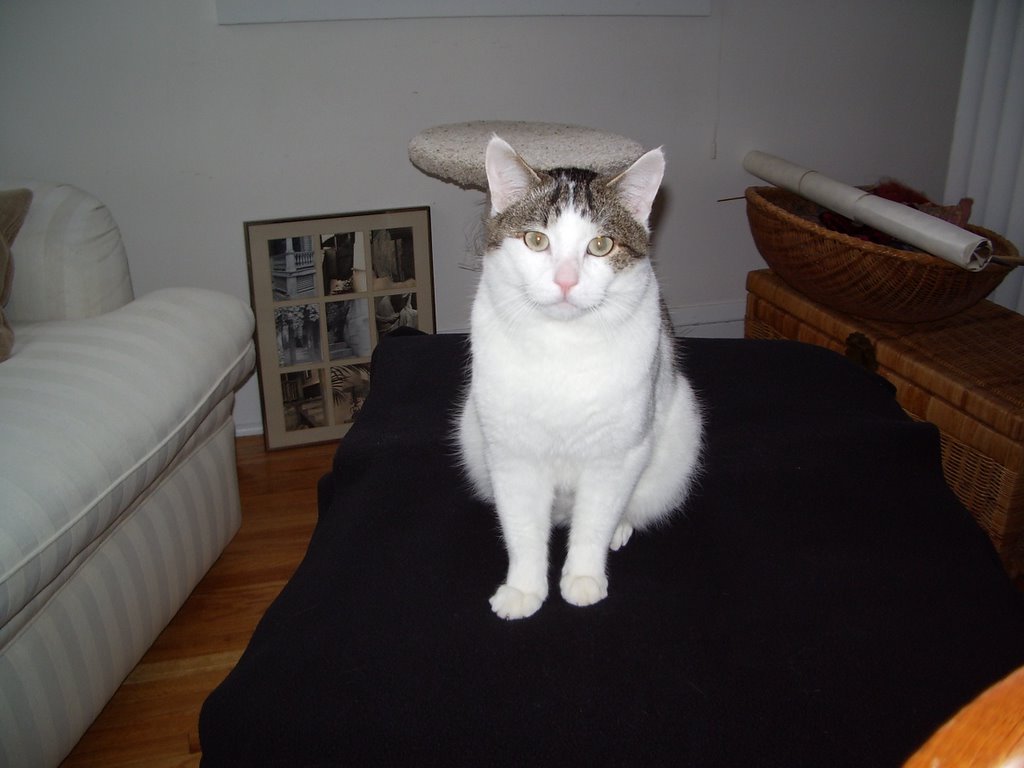
(Miko, left, in his first week with us)

Our new cat, whom we originally called Melchizedik, has had a number of name changes since we first brought him home last week. He's Miko now, which means "king" or "deity" in Japanese. We came up with the name somewhat by accident, not knowing its meaning at first. When we discovered its regal significance, we knew we'd hit on something. Melchizedik is also a king, so this feline was meant to have his royal name. And Miko fits him. He's sure of himself, and like a lovely Japanese print of a single fruit blossom, has a calming stillness. Here are the other names we considered, if only briefly.

Melchizedik, or Meli for short--He was dubbed "Mel" at the Humane Society, and we thought it could have been a diminutive of the name of this grand, biblical king. But it was a little too grand for this cat, and Meli never rolled off the tongue very well.

Lou--Our friend Malina mentioned this as a name she'd rejected for her cat. But it made us smile because it reminded us of a favorite character in a Woody Allen movie about a third-rate, has-been lounge singer by that name who's two-timing on his wife with a mobster's mol named Tina Musante. He makes it big at the end, and he has a big heart all along. My father wasn't so crazy about the name, so he added "Baby" afterward. Lou Baby.

Tiger Lily--This was the name that the neighborhood kids gave Miko, when they thought he was a girl. We considered keeping the name, but he's not as tough as the name implies.

Jack--A simple one-syllable name that SJG and one of my coworkers loved. But Miko's not a one-syllable cat.

Pinky--For Miko's pink nose, ears, and foot pads. This only lasted only a few minutes, though we liked the connection to "Adam's Rib," one of our favorite movies. " ' Pinky' ...with a "y" for him, "ie" for me," says Kate Hepburn to the judge, after she and Spencer Tracy have erupted into a spat, with private overtones, in the courtroom.

Karen Black--Another short-lived name, with resonance all the same. Miko is slightly cross-eyed from a certain angle, just like this marvelous campy actress from the 1970s. A good friend and his boyfriend are Karen Black groupies. They went to Massachusetts not too long ago for a Karen Black one-woman show. She was on the same plane when they flew home, and they got to introduce themselves to their idol.

Baby--For his sweet-tempered nature, and because it struck us as a name a Southerner like Truman Capote might give to a pet

Kiki--For the Greek owner of a Greek grocery store we frequent. This didn't stick either.

Mister--"Mister Mister" rolled right off the tongue, but we kept thinking of the rotten character by this name in "The Color Purple" so it didn't last.

And finally Miko, which is sticking and seems to fit. He's started to look up when I call out "Miko," so I think he's got his name.

Thursday, December 01, 2005

MELCHIZEDEK

He’s been watching us since April, from his perch on the neighbor’s small balcony, from the other side of the fence surrounding our yard, from the driveway across the way. We’ve seen him chasing rodents, catching birds, and hunkering under the eaves to stay out of the rain. One bitterly cold morning last month, SJG saw him running across the street. It was 4:30 AM.

It’s been a now-and-again affair. Days and weeks have passed without a sighting, and then he’s back for several days in a row. By this summer, the neighborhood had all become aware of him, and emails flew back and forth about his vicious nature—chasing away ducks from backyard ponds, fighting with other cats, keeping birds away from feeders. But I always sensed a gentler side. Gracie next door—she’s eight years old—is in agreement. She gave him a name--Tiger Lily--thinking he was a girl.

Once, this summer, I approached very slowly, cooing in low tones, and he let me pet his smooth white fur. Another afternoon on a damp fall day, I saw him crouching under a low bush in the back garden. I put an entire can of tuna on a plate on the ground a few paces from him, retreated, and watched him gobble up the treat. But I hadn’t seen him since I left for Paris at the end of September. SJG wakes up in the night worrying about him. We leave the side door of our garage open, in case he comes our way again.

The night before Thanksgiving, I dreamt that I had him in my arms, while SJG kept our brown poodle Buddy at a safe distance. And then, the day after Thanksgiving, Buddy began a particular kind of insistent barking that usually means there’s a squirrel on the window box at the front of the house. SJG looked out the window, and there was Tiger Lily, meowing from the porch steps next door.

Tuna is a seductive lure for felines. I offered him a little container of it, talked to him in low tones, and after he’d eaten it all, gently lifted him up and into the crate SJG had waiting. He’s been to the Humane Society for a physical and other tests to make sure he’s healthy, and he’s now sound asleep in my study on the thick fleece shawl my mother gave me for Christmas years ago. We’re calling him Melchizedek, or Meli for short, after the biblical king “without father, without mother, without descent.” He came to us out of nowhere, lodged in our dreams, and will hopefully become part of our family.

Sunday, November 20, 2005

BARBECUE HEAVEN

I had barbecue when I was in Kansas City (KC), Missouri, this weekend. It's barbecue heaven there, which, even if you didn't know your history, might be apparent as you land at the KC airport, where black angus cattle graze in pastures bordering the tarmac. The historic cattle drives to the railyards in KC have passed into our national lore, and though the stockyards are long gone from the city, the taste for barbecue remains.

KC-style barbecue is slow cooked over a hickory fire. The meat falls off the bone and doesn't even need the embellishment of sauce, though it's commonly served on the side. After a trip to Santa Fe last year, I became intrigued with dry rub, slow-cooked barbecue and quickly mastered the technique.

The recipe below isn't a KC barbecue recipe. It's a recipe that made its way to New Mexico with Basque sheepherders there. I offer it in tribute to the slow-cook dry rub method, which is worth the trip to the spice store and the time it takes to make this heavenly barbecue.

SLOW-GRILLED PORK

Dry Rub Ingredients:
1 TB ground ancho or New Mexican chile peppers
2 tsp ground dried chipotle or other medium-hot chile
2 tsp salt
1 tsp oregano, preferably Mexican
1 tsp garlic powder
1 tsp onion powder
1/2 tsp ground coriander
1/2 tsp ground cumin
1/2 tsp black pepper
1/2 tsp sugar
1/4 tsp dried sage

Marinade:
1-1/2 c pineapple juice
2 TB vegetable oil
4 garlic cloves, minced

Meat:
1-3/4 pound to 2-pound pork loin, spare ribs, or baby back ribs

Directions:
1) At least six hours before cooking, or the night before, stir together the dried seasonings in a bowl. Place the meat into a plastic bag (or a couple of bags if you're doing the ribs), pour the marinade mixture over the meat, and sprinkle about 1-1/2 tablespoons of the dry-rub spice mixture into the plastic bag. Refrigerate.

2) Take the meat out of the refrigerator forty-five minutes before cooking it. Drain off the marinade and discard, place the pork on a platter, and rub the rest of the dried spice mix onto the meat. Let the meat stand at room temperature, uncovered, until time to grill.

3) Fire up the grill and turn it to a low setting. Place the meat as far away from the source of heat as you can and let it cook slowly for about an hour, turning fairly often until done. If you can keep the heat low enough (300 degrees Fahrenheit), you can extend the cooking time up to two hours, for even better effect.

4) If you've chosen a pork loin, let the meat stand for 5 or 10 minutes to seal in the juices. Then slice thinly and serve with tortillas and your favorite salsa or whatever else you commonly serve with barbecue. Serves four.
SEEING IT ALL

I've never mastered cold weather fashion. Had I the resources and the guts, I'd wear fur. In fact, I saw the coat I want in a shop window in Paris last month. I liked it because the fur was on the inside, with an elegant narrow strip facing out where the coat closes in the center. But, fur is frowned upon where I live, and I'm not up for that particular battle.

So, on Friday morning when the cab arrived at 5:50 A.M. for my ride to the airport, I debated. With high winds, only a light dusting of snow cover, and temperatures in the single digits, it was cold. Normally, I'd go for layering, with multiple sweaters and several scarves under the heavy wool coat I inherited from my father-in-law. He was a big man, over six feet tall and close to three hundred pounds. I've never understood how he actually fit into the coat, but I love the weight of it and am glad to have it. I usually then stretch a lime green fleece band over my ears, top it with a bright red wool hat from my father, slip my feet into thick Smart Wool socks and sensible Rockport hiking boots, and complete the ensemble with black wool gloves. It's a comical get-up at best. But, since I was heading to a trade show in Kansas City (KC), Missouri, where it's much warmer, I opted for more fashionable attire--an elegant black top coat, leather gloves, and the new low-heeled black leather boots I bought in France last month.

The cabbie was on time--never a guarantee--and we fell easily into conversation. I'm always intrigued by the stories cabbies have to tell, and I asked mine about the longest ride he's ever been asked to undertake for a paying customer. I imagined he'd tell me about a trip to one of the neighboring Dakotas, but instead, he recalled that when he first came to the United States (from somewhere in eastern Africa), he lived and drove a cab in Nashville. One day, a woman with three large suitcases hailed his cab and asked him to drive her to New Jersey. He wondered why she didn't simply fly there. It would be much less expensive than the $1,500 he'd charge her for the journey.

The woman answered with a long story about high blood pressure and a failed Internet romance. She'd come to Nashville that day to meet the man whom she'd been dating electronically for a year. He had dumped her the minute he met her in person, and she wanted to go back home. So my cabbie accepted the proposition, with the proviso that they would convoy with a friend who wanted to drive a new car to his girlfriend in New York City. The woman agreed, and the three of them set off that day.

The trip to New Jersey from Nashville is about fifteen hours, and the woman sat quietly in the back seat of the cab the whole way, smoking one cigarette after another. When they stopped periodically for gas or a meal, she refused food and drink, and never once in fifteen hours used the bathroom.

Somewhere in Virginia, the trio ran into heavy fog. Suddenly, a deer leapt onto the road, taking out the headlights of the cab and damaging the front grille. Wanting a police incident report for insurance purposes, the cabbie and his friend pulled over to call for help. The woman became visibly agitated, shaking uncontrollably and demanding that she and her bags be deposited down the road a stretch, where the cabbie could pick her up later. Though perplexed, the cabbie did as she requested while his friend called for help. The police arrived, the cabbie got his paperwork, and the two friends were on their way in short order, picking up the woman at the agreed-upon spot.

The rest of the trip passed without incident. The convoy crossed into New Jersey, and the woman directed them to her suburban home. As they drove up to the house, three large men in black suits--three very large men--moved forward shoulder to shoulder across the front lawn. The woman, completely calm, seemed to be expecting the giants. She stepped out of the car and pulled out her bags. One of the black-suited behemoths stepped toward the car and said to the cabbie, "Get out of here now. And don't look back."

In a flash, it all came together. This was a drop. Drugs, cash, the cabbie could only guess. He took his payment--$1,000 in cash, the rest in a personal check (which later bounced)--turned his car around and didn't look back.

In wide-eyed wonder, I exhaled. "Wow," I said. "You guys see it all." The cabbie chuckled ruefully in agreement. We wished each other safe passage and parted, he to another fare, me to the KC-bound DC9, which roared down the runway, lifting up into the skies as if we weighed no more than a feather.

Thursday, November 10, 2005

RIOTS IN FRANCE

These last two weeks, a few friends, colleagues, and family members have expressed relief that I’m no longer in France and am back home…safely. They’ve been reading about and watching scenes of the urban violence that has gripped the French nation since the end of October. My father and I left Paris just as the violence was beginning; we weren’t actually aware of it until our return.

Those around me are kind in expressing relief for someone they care about, me, and in talking about the violence in France, they are bringing up a subject they know I care about, France. I point out that the violence has been confined to the immigrant ghettos that ring French cities. Tourists haven’t been targeted, and they never venture into those areas anyway. But I’m a little puzzled by the shock and surprise, even confusion, that I sense in conversation about the situation in France.

The riots in France come from within the economically and socially isolated postcolonial immigrant underclass, largely African and Muslim, in whose communities unemployment is more than three times the national average. The ugliness of racism, substandard housing, and harsh dealings with the police are daily realities. Additionally, the violence is set within the context of posturing for the upcoming French presidential elections in 2007, in which the ascending tough-talking Right offers what many view as inflammatory, insulting commentary about the immigrant communities in France; the more moderate centrist candidates talk of dialogue and action plans.

In thinking about what any kind of so-called action plan might look like, I’m reminded of the shared philosophy of former U.S. presidents Jimmy Carter and Bill Clinton, who, in separate venues, both spoke recently of the political and human wisdom of extending generosity toward, of offering opportunities for those who face social and economic destitution. They both point out that, without hope, despairing people, whether rightly or wrongly, often turn to violence. And in many cases, as in France this month, that violence is turned inward onto the troubled community itself.

When I read about the riots across France, I see individual faces in my mind’s eye. Faces like the Arab men at the cybercafe around the corner from our Paris apartment. They run their own small business and are knit into the socio-economic fabric. But I wonder what they might turn to, what any one of us might turn to, had we no investment in the community in which we lived, no hope, no sense of a loving and promising future. I’ve seen it up close. My mother fit this exact profile. Her despair turned inward. She bought a revolver, and on December 14, 2002, pulled the trigger and ended her life.

Sunday, November 06, 2005

RADIANCE

For my mother, who would have been seventy-one today

As my father and I help the chauffeur put our bags into the back of the taxi mini-van, the boulangere (baker) and the man from the papeterie (card and paper shop) next door to us step onto the sidewalk on their respective sides of the street to wish us bon voyage. I feel a pang. My efforts to befriend my neighbors in Paris have paid off, and here I am leaving them behind. With a promise to return next year, I step into the taxi, and we head off to the airport for the flight home.

On the airplane, my father and I eat the sandwiches and the sables (sugar cookies) the boulangere had packed for us that morning, watch movies on our individual video screens, and try to sleep. Now and then, I crawl over my father into the aisle to stretch and make a walking tour of the cabin. In the back of the plane, two seated flight attendants look up as I come toward them, move their legs to make room for me to squeeze past, and go back to their woeful tales of debt and family treacheries. Looking out the window from my seat, I wonder if home will seem any different. Or will it be as if I’d never left?

My father is a man of the moment. When we set foot on American soil, he’s left Paris far behind. Walking out of the customs area and toward our connecting flights, he stops a complete stranger to get the details of the World Series, which took place while we were in Paris. I’ve read in Le Monde that the Chicago White Sox had won, but he wants more than that. And the young man my father grabs is friendly and obliging. He tells us about the games, and by the time we finally part, he’s shared half his life story and gleaned as much of ours. I know I’m home. Immediate intimacy is not the French way.

My father and I part with little sentimentality. We hug and agree to call each other when we arrive home. I watch him as he heads off to catch his flight. He doesn’t look back, though I watch him until he’s out of sight.

The final leg of my journey comes with a West Virginia accent. The man in the row behind me is from that state and is terrified of flying. He informs anyone who will listen—and that’s half the airplane, since he’s talking at top volume—that he’s got ahold of his seat cushion, just in case we go down. As we land, safely, he exhales with obvious relief and exclaims, “My God! It’s flat as a pancake here! Donch’all have any mountains around here?”

Home doesn’t seem to have changed much, but I can tell that I’m seeing it differently. I’d somehow overlooked what a friendly lot we Americans are, easy with strangers, quick to laugh, sure the fellow next to you will want to hear your tale.

And when I return to work two days later, people do want to hear my tale. They ask about the cooking, the weather, traveling with my father. Peggy, hired just before I left, has an office next to mine. She loves Paris and wants to hear the long version. So I tell her of not just loving, but of being in love with Paris, of the joy of speaking French and deepening my mastery of the language, of learning new culinary techniques, of exploring new corners of the city. She interrupts me mid-sentence. “My,” she observes. “You’ve got such a glow!”

Her words catch me off guard. They take me back to the final conversation my sister had with our mother, just two weeks before our mother’s death. In that conversation, on the phone, my mother had said she hadn’t always known what life was all about. “But,” she told my sister, “I’ve come to see that it’s all about radiance.”
My sister expressed shock. “You’ve always known that!” she insisted, trying to impress this fact upon our mother. “You taught us that.”

My mother lived a life of radiance from start to finish, never going half measures on anything. It’s true that her glow was dark, as often if not more than it was brilliant, but she always shone. And to the extent that radiance is a form of love, of being so full of something that the surfeit comes out as brilliant energy, I sometimes think I can feel my mother’s radiance, from the other side, and I want to believe that today, on her birthday, as on every other day, she can feel mine.

Friday, November 04, 2005

SOUFFLE AU CHOCOLAT

Souffles are a quintessential French oeuvre, which, when inflated to perfection, give the cook a sense of mastery, if not triumph. La Chef says that most Americans request a souffle as part of the menu. A chocolate dessert souffle is an easy way to fulfill that request as well as to satisfy our national obsession with chocolate. If you follow the instructions, have the right equipment, and practice faith, your souffle will rise to the heavens before your very eyes.

1 cup milk
4 oz Valrhona chocolate (or an equivalent bittersweet chocolate such as Scharffen Berger), broken up into small pieces
1 oz sweet butter
2 TBSP flour
4 eggs, separated
1 pinch salt
1-1/2 oz white sugar
powdered sugar (optional)

1) Preheat the oven to 475 degrees Fahrenheit. Coat the insides of 6 individual souffle ramekins with melted butter and set aside.
2) In a small saucepan, bring the milk to a boil, remove from heat, and add the chocolate. Stir until the chocolate is melted.
3) In a separate medium saucepan, melt the butter with the flour. Cook for 1 minute, then add the chocolate-milk mixture. Stir over low heat until thickened, without letting the mixture boil.
4) Remove the pan from the heat and add the egg yolks one at a time, mixing thoroughly.
5) Beat the egg whites with a pinch of salt until stiff, adding the white sugar a little at a time when the whites are almost fully stiff.
6) Fold the stiff egg whites carefully into the souffle mixture in the pan.
7) Fill each ramekin about 2/3 full with the souffle mixture.
8) Place the ramekins in the hot oven (475*) for 2 minutes. Then lower the temperature to 350 degrees Fahrenheit and bake until risen (about 15 minutes). It's best not to open the oven while the souffles are cooking, though you will want to peak through the oven glass occasionally to supervise their progress.
9) When inflated to perfection, remove the souffles from the oven and serve immediately. If you like, you can sprinkle a little powdered sugar on top of each souffle just before serving.

Serves 6.

Wednesday, October 26, 2005

UNE CONVERSATION A QUATRE PLATS
(A Conversation in Four Courses)
--dedicated to my father, who said yes

Last night, my father and I had dinner with La Chef and her friends Patrizia and Andre. Patrizia is American, and Andre is French. They met as undergraduates in the United States some twenty years ago, married, and have made their life together in Paris. They have known La Chef for many years and share a common circle of friends.

My father and I arrived early to help with the cooking, and La Chef had even printed out copies for us of the recipes for the evening's meal. We drank a Cote de Bordeaux as we cooked and changed to a dry champagne after Patrizia and Andre arrived.

L'ENTREE (The First Course)
La Chef and I had begun negotiating the evening's menu days before, and since it is fall, I wanted our choices to include seasonal chestnuts and rabbit. We went back and forth on the chestnuts: souffle or soup? soup or souffle? A chestnut souffle is, by definition, a dessert, so with other ideas in mind for that course, we opted for a chestnut veloute (cream soup) with a surprise ingredient. As we ate the soup, a lovely light brown, served in small yellow bowls, La Chef quizzed the dinner guests. Could they identify the secret ingredient? My father finally guessed that it was chocolate, and La Chef pulled out a small round container of Valrhona Xocopili, the French take on Mexican chocolate, which La Chef is quick to clarify comes from Aztec culinary traditions.

Patrizia points out that, had we been eating our chocolate soup in Aztec times, only the men at the table would have been allowed to enjoy it. Chocolate was a food reserved for men, usually the priestly class, in Aztec culture. My father adds that Aztec women were prized, too. As sacrificial beings. Patrizia mentions having read, in fact, about anthropological discoveries of the remains of monkeys and humans in Aztec middens. The conversation turns accordingly toward canibalism in modern times, something about which I've learned from my sister. She's written a book about Malaysia this year and included a piece on canibalistic practices in Borneo. The British officially outlawed canibalism there in the 1930s, but it continues anyway, despite the interdiction.

LE PLAT (The Main Course)
The main course is lapin aux pruneaux (rabbit with prunes), a lovely, braised rabbit cooked slowly in a cast-iron cocotte with red wine and butter and seasoned with shallots, a little garlic, a bouquet garni, and lardons (small chunks of bacon). La Chef has been all over town on the search for this rabbit. At this time of year, rabbit is common on French dinner tables when guests are invited, and the Sunday market butchers are mostly sold out by the time she gets there at noon. Finally, at the big Bastille market, she finds what she's looking for--even bigger and meatier than she'd dared hope for--and returns home in triumph.

When the rabbit is almost done, we add big, plump prunes and a handful of raisins and let them soften in the ample pan juices for a few minutes. La Chef then makes a simple sauce by reducing the liquid until it is thickened. She serves the rabbit in a clay tagine, which her daughter brought back from Morocco for her one year. I brush clean a heap of dark black trumpetlike mushrooms, soft and damp to the touch, called trompettes de la mort (trumpets of death). Along with a puree de pommes de terre, the trompettes will be our side dish. With this course, we drink a lovely Russian River red, brought from California by one of La Chef's students.

Conversation drifts toward politics, and I ask Patrizia if, through her marriage, she has become a French citizen and has voted in French elections. She confirms yes on both counts, and I bring up the recent referendum in France on the European Union constitution, which sharply divided the French electorate. Drafted behind closed doors and mailed to voters to interpret on their own, the eighty-page constitution left the majority of French voters feeling isolated from the political process and angry at their political leaders. The constitution was voted down in France; Patrizia and Andre were split. She voted for, he against. La Chef not only voted yes, she also campaigned for the referendum, standing on a street corner one Saturday afternoon handing out literature to passersby.

Her campaign was short lived, however. When a passing man took one of the tracts and began to quiz her on Article 5, Subsection 13, she froze. La Chef is an urbane intellectual, but even she had not fully digested the giant constitutional tome. Unable to respond to the man's challenge, she gave up her campaigning on the spot. Andre says the constitution was excellent bedtime reading. It put him to sleep every night for a week. In the meantime, the constitution is "under reflection," and eventually, a new draft will come to a public vote.

LE DESSERT (Dessert)
After the cheese course--luscious, ripe Vacherin--Patrizia slices each of us a piece of the almond-fig tart that La Chef and my father have made. After pulling it out of the oven, they placed fresh raspberries among the figs and sprinkled chopped Sicilian pistachios over the top. During dessert, my father mentions that I've been teasing him about his bad French, and Andre asks for examples.

One of my favorites is, "Les toits, c'est moi!" ("I am the roofs!"), a mispronunciation of Louis XIV's famous "L'etat, c'est moi!" ("I am the state!"). Another is, "cheminee sur la chaussee," which, in my father's mind, refers to going somewhere on foot, but which to my ears sounds like a reference to a fireplace or chimney ("cheminee") on the sidewalk ("la chaussee"). Andre corrects me. He says my father's errors are poetically nineteenth-century in nature. "Cheminer," which sounds just like "cheminee," is actually an old-fashioned verb that refers to making one's way or to taking a leisurely stroll, so he's not surprised that the woman to whom my father addressed this phrase understood what he meant. And, to a French ear, Andre says, "les toits" ("roofs") would never be associated linguistically with "c'est moi" ("it is I"). Rather, a French person would hear "les tois" as a pluralization of the informal "toi," or "you." This turns my father's rendition of the royal proclamation into something much more profound than staking a claim to the roofs of France. "Les toits, c'est moi!" would mean that the king subsumes the people; all the yous (the people) are his. My father swells with pride, and I'm reminded of the complexities of language, of the many layers of linguistic knowledge that accrete over time for true mastery.

LE THE (Tea)
French meals usually end with coffee, but since it's late, after eleven, La Chef instead serves us an infusion de tilleul (a tea made from the slender, dried leaves of the lime tree). It's a very mild yellowish green tea, barely coloring the small glasses into which La Chef pours it. Andre tells us that French tilleul is threatened by the Chinese domination of the tilleul market; La Chef confirms that it is French tilleul we're drinking tonight.

For my help in class, La Chef has teased me about preparing a certificate of achievement for my efforts. I've told her that what I'd really like is to make a short film of her, using the new digital camera from my father. She has agreed to the idea, and after tea is served, announces that now is the moment to make the film. I've brought my camera, but knowing that Andre is knowledgeable about movie making, I'm nervous. So, I cloister myself in the small bathroom off La Chef's kitchen to make sure I've got everything under control.

I hear robust laughter behind me as I scurry from the room, but once I reemerge, La Chef sits up straight, ready to be interviewed, and the guests sit quietly so we can make our film. La Chef is a natural, talking easily about her work and the culinary principles she aims to share with her students. The film seems to make itself, and I promise to send a copy to La Chef when I get home. We finish our tea on other topics--film making is nothing special in this group. At midnight, my father points to his watch. The Metro stops running at twelve-thirty, so it's time to say our good-byes. Walking to the station, I feel contented, with the meal, with the conversation, with my film, and with the possibility of new friendships that I have found in this beautiful city.
LA MODE A PARIS (2)
Fashion in Paris (Part 2)

KIDS (BOYS): U.S. baseball caps, often worn backwards; scarves; all colors, except black

KIDS (GIRLS): hats, hats, hats; dresses and jumpers; appliqued flowers on dresses and coats; striped tights; scarves; all colors, except black

MEN: Puma tennis shoes, mostly in neutral colors

WOMEN: zouave pants (casual pants that puff down toward the ankles); sweater coats to the knees, usually in neutral colors such as white, beige, and black; loosely crocheted ponchos, often in wild monochromatic colors; poofy taffeta (rather than satin) jackets and matching layered, poofy skirts (usually in monochromatic tones); Puma tennis shoes in neutral colors as well as red or pink; suede boots to the knees, often with a fold-over flap at the knees; pashmina shawls over evening wear, wrapped loosely in front and thrown over one shoulder for panache

Tuesday, October 25, 2005

MIND OVER MATTER

Today was my last day assisting La Chef. She's invited my father and me to dinner before we leave, but that will be a social event--no students. We'll make lapin aux pruneaux (rabbit with prunes) that evening, a very French dish that La Chef rarely makes in class. Americans aren't generally interested in eating rabbit.

Today in class, we make a veal roast as the centerpiece, doing only a little shopping at the local market in the morning. No stop at the boucherie or the caviste on the way home--La Chef has purchased everything but the cheeses, carrots, and bread the day before.

The students today are a congenial group who hit it off right away: a middle-aged man from Victoria, B.C., a retired woman from Manhattan, a woman from Berkeley who is in Paris to look for an apartment, and, arriving late, a mother-daughter pair from New Jersey. They're here to celebrate the mother's fiftieth birthday, and the trip to Paris--complete with cooking class--is the daughter's birthday gift to her. La Chef tells me to stay behind at the Metro station to wait for them. We'll catch up with the rest of the group at the cheese vendor's stall.

When the mother and daughter finally surface, they practically throw themselves into my arms in relief. They've only just arrived the day before, with multiple delays and a wake-up call this morning that never came through. I orient them to the day's activities, and we meet up with the rest of the class to finish our shopping and head back to La Chef's kitchen to begin our work.

La Chef doesn't have to direct me much today, since we've got our system down, and she remarks that, when I leave, she's going to miss my efficiency and ability to second-guess her. I'm going to miss her warmth and generosity, and all the good food we've been making.

Along with the veal roast, we peel and slice carrots to cook slowly in a bath of butter, honey, and an exotic Moroccan blend of twenty-four spices called Raz el Hanout. It's my job to brush off all the dirt and moss from a large bag of rich yellow girolles (chanterelles mushrooms) that we'll saute for a side dish. Then we dip small crottins de chevre chavignol (rounds of goat cheese) in egg, then in breadcrumbs, and saute them in olive oil to serve atop a bed of mixed greens dressed in a light vinaigrette. For a final touch, we assemble the fixings for a roquefort souffle, melting the cheese in the roux before folding in the egg whites and pouring the mixture into individual ramekins. To accompany the meal is a Bordeaux that comes from the vineyard of La Chef's vintner friend. We end the meal with La Chef's famous chocolate-apple tart. She praises the Valrhona chocolate--a French chocolate from the valley of the Rhone River--which she uses exclusively.

Oddly enough, none of the students has opted for the afternoon tour of Les Halles, though by the end of the meal, they all want to buy tart pans and a year's supply of the intriguing Raz el Hanout. La Chef has other commitments, so she asks me to take the class to the spice store for her and to then direct them to Dehillerin, an iconic kitchen supply store. I would go with them to Dehillerin as well, but I have a massage appointment late in the afternoon and will have to hop on the Metro as soon as we're done at the spice shop. La Chef has called ahead, so the owner of the shop is expecting us when we arrive. He explains the long history behind Raz el Hanout. Every corner spice grinder in Morocco has a unique version, blending his own combination of spices. The mix came to France through the Arab conquest of Spain centuries ago, the cultural influences of which drifted north into France over time. Said to have aphrodisiacal powers, Raz el Hanout was also traditionally used for medicinal puposes, especially for women after childbirth.

We say our farewells, and I head to the Madeleine area for my appointment at L'Espace France-Asie (EFA, or France-Asia Space), where O. will give me my weekly traditional Thai masage, followed by a treatment of medicinal herbs that warm slowly in a small electric heater at the foot of the futon on which I get my massage. I arrive a few minutes early, as does a trim fellow about my age in a business suit. He is a little flustered and talks to the receptionist about the awful traffic he encountered on his drive over to the EFA. She advises him to ride his bicycle next time, and he replies that he doesn't want to die young.

I laugh out loud. The idea of riding a bike in Paris at rush hour, fighting with cars, scooters, and pedestrians for space on the narrow streets seems ludicrous, especially if, like most Parisian cyclists, you choose not to wear a casquette (helmet). I mention my thoughts on the subject to the fellow, and as we drink the green tea served by the receptionist, we fall into conversation about physical exercise in Paris. I ask about lifting weights, and he launches into a description of his wife's routine at her gym: weight lifting, stretching, swimming, and yoga. I tell him that I do all those things at home too, but that yoga and stretching have become difficult lately due to a painful strained hamstring muscle.

He tells me not to give up. Pain, he says, is ninety-five percent psychological. From there, we're deep into a philosophical discussion of consciousness and the extent to which the human experience of what we call reality is centered in the mind or in the body. I see his point: the mind and the human emotional perception of being are powerful energies, often underestimated in the industrialized Western world. But, I muse aloud, we're both here at the EFA to tend to the five percent of experience that is entirely corporal. When O. calls me for my massage, my stomach grumbles, reminding me of the recent pleasures of a satisfying repast. And I'm glad, in that moment, for my corporal incarnation.

Monday, October 24, 2005


PIZZA MONTAGNARDE
(Mountaineer's Pizza)
--Dedicated to SJG, who's patiently waiting at home for her Reblochon

My father and I discovered this French pizza at Le Relais du Chateau, the little pizza-to-go shop across the street from our lodgings in Azay-le-Rideau. The shop has a window onto the street where you place your order and can watch the very friendly chef make your pizza. When our pizza was done, we took it back across the street to our overgrown garden and ate it under a bower close to the house as a light rain began to fall.

Pizza Montagnarde
1 pizza crust for a 9-inch, thin-crust pizza (not pre-baked)
2/3 cup creme fraiche, or enough to cover the crust well
3 small yellow potatoes, peeled, boiled to almost done, and then sliced into medium-thick rounds (or mashed is easy too)
6-8 narrow slices of Reblochon cheese (a cow's milk cheese from the alpine Savoie region of eastern France)
1 round of fresh mozzarella, cut into bite-sized chunks
1-2 medium yellow onions, caramelized
a few kalamata olives

1) Pre-heat the oven to 400 degrees Farenheit.
2) Place the pizza crust on a pizza pan (or pizza stone, following instructions).
3) Spread the creme fraiche evenly over the crust.
4) Arrange the potato slices in concentric circles, leaving space for the pieces of cheese. If you're using mashed potatoes instead, spread them evenly over the crust.
5) Place the pieces of Reblochon and mozzarella among the potato slices and distribute the caramelized onions evenly over the top.
6) Place the olives on top and bake the pizza for 15 minutes, or until crust is browned and the cheeses are bubbling nicely.

Season to taste with freshly ground black pepper or with a hot-pepper infused oil and serve with a sweet white wine. Serves two.

Friday, October 21, 2005

LA MODE A PARIS
(Fashion in Paris)

MEN: jeans or a black suit; scarves; leather, tie dress shoes; short hair, carefully trimmed facial hair, no sideburns of any kind; piercings (facial, tongue, ears); black, black, and more black.

WOMEN: layered skirts (cotton, wool, or rayon) on the bias, often with matching layer of voile exposed about 4 inches at the bottom; satin skirts and matching jackets, as puffy as possible; flared 3/4-length skirts; mini skirts; scarves; sparkling appliqued sequins on jackets and tops; lime green anything paired with reds or purples; tight flared jeans; hip huggers with wide black belts; converse tennis shoes of any color; fringed head scarves for black (African) women; ballet slipper-style shoes; black leather boots in general; cowboy boots specifically, black, low-heeled and extremely pointy toes (I bought a pair for myself in shoe-town heaven); plastic glasses with monochromatic colored frames (red and green are popular); long hair, pulled up in a bun or hanging loosely; leather backpacks slung over one or both shoulders; piercings (facial, tongue, ears, though more common on men); black, black, and more black.

Thursday, October 20, 2005

"I HAVE CREATED ENCHANTMENT"

As we speed out of Paris on the TGV from the Montparnasse station, the cityscape gives way quickly to expansive, flat agricultural fields, now mostly barren. Occasionally, a tractor or a grouping of baled hay come into view. We're on our way to Tours for a visit to the chateau country of the Loire Valley. Last year, we visited castles along the Cher River, a tributary of the Loire; this year, we're to see the sites along the Indre, another of the Loire's tributaries. The train is packed, though quiet, and the woman up ahead of us shares her sandwich with the dachsund seated comfortably on her lap.

It's a short trip from Paris to the TGV station outside of Tours, where we pick up our rental car--a sporty, keyless Renault Megane--and are quickly on our way. My father has memorized well in advance the map of the region and tells me which signs to look for. Our first stop, the chateau of Villandry, is not far, only 20 kilometers, but the route there is a maze of frontage roads, four-lane expressway, and winding country lanes. The trees are turning red and mist is still rising off the valley floor. The air is cool, and I'm glad I've packed my wool sweater.

At Villandry, built in 1536 by the finance minister to Francois I and owned privately since the early part of the twentieth century, we start our tour in the potager--the kitchen gardens. Laid out in nine squares, the garden is bursting with geometrically patterned rows of fall produce and herbs--pumpkins, leeks, cabbages red and green, decorative kale, peppers, celery, and bushy purple basil. In the corners of each square are staked tree roses in full bloom, and along the periphery of the potager are fruit-bearing pear trees. Gravel pathways dissect the potager, and small fountains in the central gravel artery spray gentle arcs of water into the air. Few people are here at this time of year, so my father and I stroll peacefully through the potager, into the neighboring medicinal garden, and up a set of stairs along a terraced canal to the water garden above. A single swan grooms his white feathers in the large central basin, on either side of which spreads a labyrinth of immaculately groomed boxwood hedges, interrupted only by several circular fountains.

We wander to the back of the property to the greenhouses, empty now, and return by way of the ornamental gardens. The boxwood here is trimmed in geometric patterns symbolizing different kinds of love--tender, passionate, fickle, and tragic. It's a "love garden" in greens (boxwood) and reds (impatiens), and I'm struck by the possibility for beauty in the simplest of plants and in the most basic of geometric forms.

Late in the afternoon, after ambling through the chateau itself, which offers a splendid aerial view of the gardens from the rooftop of the keep, we make our way to the town of Azay-le-Rideau, where we'll spend two nights and visit the chateau of the same name in the morning. Azay is a small town, and as we drive in, everything seems to be closed. Few people are on the street, and when we miraculously find ourselves in front of our chambre d'hote (B&B), even it seems to be shut up. The giant green gates to the side don't give when I push, and the front door is locked too.

I push a buzzer off to the side and wait an eternity before an older woman, Madame B, opens the door. She seems suspicious, so I quickly explain who we are and that we have reservations to stay there. She offers a quiet smile and steps out onto the sidewalk in her flowing silk pants, her hair falling loosely down her back, to explain the complexities of parking the car at the back of the property.

We park the car and walk up to the house along an allee of cypress trees and bamboo and through the back garden, a mass of giant climbing roses, yucca in bloom, a single pink hollyhock, and small urns of fading geraniums perched atop the columns of the low stone wall surrounding the garden. Rusting, antiquated iron chairs and tables cluster near the house, which is filled with fading Oriental carpets, giant armoires and marble-topped tables, cheminees (fireplaces) in every room, and Nabob, an Afghan hound sitting regally in the darkened parlor. Crumpled lace and heavy linen curtains hang from the floor-to-ceiling windows, and oil paintings and sketches line the walls at awkward angles.

Madame B takes us to our rooms on the premier etage (second floor). We have a suite overlooking the back garden. On closer inspection, I notice that the floors slope, the antique dressers and armoire are in less than perfect condition, and the greyish blue paint of the French windows in the bathroom is peeling. Madame B leaves us to settle in, and my father whispers to me, "I think Blanche DuBois lives here!" I'm touched by the way he's hit on the exact mood of the place, its faded glory, its worn elegance, its charm. And, like Blanche, there's something fragile here, something sad, and I wonder if it's the way Madame B, with her aging antiques and her bohemian garb, seems to be preserving a nostalgie d'autrefois, a love for a long-ago way of life. With her elegantly draped lamps, covered in linens, lace, and tassled silks, Madame B has created an enchantment in the face of a reality I can't quite pinpoint.

And, the next day, I catch a glimpse of it. As I return to the house from a trip to the nearby post office and turn my big brass key in the lock at the front door, I see a small doorway into a little room I'd not noticed before. On a hospital bed, only the end of which I can see, stretches a skinny pair of old legs, pushed into white therapeutic stockings to promote circulation and slippered in oversized bedshoes. Illness and mortality emanate from the room into the hallway, and I feel the tremendous courage of all the Madame B's, of all the Blanche DuBoises of the world, who drape their heartbreaking realities in beauty.

Wednesday, October 19, 2005

A BIG FRENCH MESS

The other day, I went to A. Simon, a wonderful kitchen supply store in Les Halles. It's off on a side street that angles away from the post office on the rue du Louvre, the post office that's open twenty-four hours a day, seven days a week. I wanted to buy bread knives for my partner's sisters and a variety of bowls and plates, large and small, made by the famous French porcelain company Pillivuyt. I knew A. Simon would be well stocked; I'd bought little white ramekins there on a previous visit and experienced their impressive collection.

The store was quiet when I arrived, and an older man in suit and tie stepped forward to help me. I told him what I was looking for and the sizes I needed, and he took me to the various corners of the store to choose exactly what I wanted. As he wrote up the sales ticket (by hand), I explained that I was hoping to have everything shipped back to the United States, and he looked at me somewhat askance.

"You know it's very expensive to do that, don't you? The laws have changed," he said, "so it will likely cost you more than the dishes themselves to send them back to the United States."

I assured him I was prepared for some expense, and he took me to la caisse (the checkout counter) to pay for the knives and dishes. We agreed that he would call me the next day with the exact euro amount for the shipping. It was understood that the transaction was dependent upon my final okay. I extended my hand to shake hands with him for being so helpful and learned that I had been dealing with none other than Monsieur Jacques Simon, one of the brothers who own the store together.

The next morning at nine o'clock, which is early in France, the phone rang. It was M. Jacques calling to let me know that the total cost of expedition to the United States (including shipping, handling, and insurance) would be 309 euros (roughly $386), indeed well over the cost of the purchase itself. I asked for some time to consult with my family at home and promised to call him back the next day.

My partner and I, laughing together, decided that the price was too exorbitant, and we settled on the knives and four small salad bowls only, a compromise that I can easily carry home in my hand luggage. Experienced in French retail habits, however, I knew I was in for some negotiating. Changing your mind and returning things in France just isn't done. And, since much here is dependent upon relationship, I knew I would need to handle the situation in person.

So, I went back to A. Simon after cooking class the next day and asked for M. Jacques. He was out at lunch still, so Brigitte helped me instead. I explained my case and that I wanted to take only a selection of the original sale home with me that day and to be refunded the difference. The French get a certain stern look in their eyes when you've asked for something that they view as odd or importunate. I got that look. Brigitte took out her cell phone and made several calls while filling out, by hand, a new sales ticket for the items I did want. I followed her around the store as she verified item numbers, supply, and prices, talking on the phone about me as she went.

She painstakingly compared the new receipt with the old one and finally took me to la caisse to settle my account. There, she began to explain the situation to la caissiere (the checkout clerk), who refused to comprehend her own role in the transaction. Brigitte patiently explained things to her three more times, at which point la caissiere got out her handwritten ledger and made copious notations related to my sale. She then made Brigitte write out a note on the sales ticket explaining the reimbursement, made her sign it, made me sign it, and made M. Jacques--who had by this time returned to the store--sign it too. The entire file, a dossier really, since everything in Frances is in triplicate, was then clipped together and carefully inserted into la caissiere's ledger book.

Thinking I was nearing the finish line, I took out my VISA card, assuming the reimbursement would be credited to it, since I'd originally paid with plastic. For mysterious French reasons, it was made clear to me--despite my protestations and pleas--that the reimbursement, which was well over 100 euros (roughly $125), would have to be made in cash. I wondered about the sanity of such a policy, but since I wasn't making any headway on this particular point of business, I decided to take the cash, thank Brigitte and M. Jacques for their patience and help, and be grateful that the entire negotiation had taken only half an hour. I'll buy the pasta bowls and plates next year.
LE MARCHE OBERKAMPF
[dedicated to Paul, for the dessert below]

On Friday morning at nine o'clock, I'm to meet La Chef and her six students of the day at Le Metro, a big corner cafe on the Boulevard Voltaire. The night before, I get out my Metro map to plan my route. The easiest way, though not the most direct, requires only one correspondance (change of Metro lines) at a small station on the Right Bank. I try to avoid the big stations--mazes of hot, underground passageways, where multitudes rush to catch their trains. I arrive at Le Metro right on time, and when I come up onto the street, I spy a group of six waiting in front of a large kiosk. They're obviously together, though they seem uncomfortable as a group, so I make my way toward them to introduce myself. Indeed, it is La Chef's group, and they're relieved to have a leader. La Chef hasn't arrived yet, so I explain my role and that she will join us shortly. La Chef lives right in the neighborhood.

The group is American, and as we share our coordinates, it's clear that we represent a broad swath of the continent. Two of the couples are from California, a young pair who live near Irvine, and two lawyers from the San Francisco area. Hailing from the other coast is a businesswoman from Boston, and in the Southwest, a merchandiser who has retired in El Paso. With my midwestern roots, I represent the midcontinent.

Within a few minutes, La Chef arrives. She looks lovely in a safari-style pant suit, ropes of colorful glass beads wound around her neck. She must have rushed out of the apartment this morning, for I notice that one of her pant legs is caught in her stocking. She introduces herself and talks a little about the wealth of weekly outdoor markets in Paris. There are about sixty of them, and today, we're going to the Marche Oberkampf, a Friday morning market.

Our menu will resemble the others: a cheese-tasting course for starters, a curried cauliflower veloute (cream soup), and a salad of fresh mushrooms and roasted beets, followed by a main course of puree de pommes de terre (mashed potatoes) and herb-stuffed tenderloins of pork and veal. For dessert, we'll make an almond-fig tart.

Since La Chef hasn't had time to do her usual day-before shopping, our grocery list is more comprehensive today. We have to buy just about everything, so we stop for ingredients from the market's cheese and dairy, fruit, vegetable, and fresh herb vendors. La Chef knows all her providers, and at the herb stand, we're treated to photos of the vendor's baby daughter. Just two months old, her name is Elisabeth. Then we're off to La Chef's boulanger for baguettes and to the boucherie next door for the veal and pork. The butcher cuts thick scallops for us, slicing pockets into the meat where the herb stuffing will go. Our final stop is at the caviste for wine. After an extended negotiation with La Chef, the caviste suggests a Syrah Cuilleron, a light-bodied red.

I'm becoming familiar with La Chef's routine by now, so when we get back to her apartment, I pour a carafe of water for the students, unpack the groceries, arrange the cheese plate, and start rinsing the fresh herbs. Little except the milk, creme fraiche, and meat go into the refrigerator, and there, I've made another mistake. La Chef likes to cook her meat at room temperature, and in her mind, even the dairy can remain on the countertops, since we'll be cooking with it soon enough. An animated conversation about bacteria and hygiene ensues, with no real consensus other than that the French and we Americans treat food very differently.

We start by chopping the herbs--tarragon, Italian parsley, chives, and chervil--and a handful of baby spinach. Together, the chopped greens are called a chiffonade, for the way they resemble strips of cloth or ribbons, and we set them to cook slowly in butter. La Chef chops a beautiful creamy white cauliflower into large florettes and places them in a casserole to cook slowly in milk, cream, and a sprikling of curry powder. Next, we chop the mushrooms and roasted beets--sold already cooked--for the salad, drizzling fresh lemon juice and olive oil over the top. Soon, the chiffonade is soft and ready to stuff into the veal and pork scallops. La Chef does not wash her meat before handling. "E. coli" and salmonella seem to be of no concern here.

Once we've stuffed the meat with the chiffonade, we roll the pieces in homemade breadcrumbs (crushed nuts is another option that my father and I try the next day with walnuts he picked in the Dordogne) and saute them in two large pans. Next comes the tart, a simple preparation once the crust is partially baked. For the almond filling, we cream together butter (82% butterfat), sugar, a little flour, and powdered almonds, adding an egg and kirsch to make a moist paste. The young woman from Irvine helps spread the paste over the crust. She's hoping to become a pastry chef and has been accepted at Le Cordon Bleu's California pastry school. Classes start in January.

In the oven, the paste cooks briefly in the crust while we slice fresh figs to arrange carefully over the top. The tart goes back into the oven for another few minutes to release the juices of the blood-red fruit, and we turn to pureeing the cauliflower and preparing the potatoes. At last, we direct our attention to the final preparation of the meal--the sauce for the meats. Sauces can seem tricky, but if you've got a nice cut of meat with plenty of natural fatty juices, the work is done for you. One of the San Francisco lawyers lifts the scallops out of the frying pans and onto a platter, and his wife adds white vermouth to deglaze the pans, turning the heat up high to thicken the mixture of wine and drippings. At the last minute, La Chef directs her to stir a dollop of creme fraiche and another of French mustard into each pan, and lunch is served.

ALMOND-FIG TART
1 partially baked pastry crust for an 8-inch pie
2 pounds fresh figs
1/2 cup sugar
1/2 cup powdered almonds
1 TBSP flour
3 ounces softened, unsalted butter
1 egg
1 TBSP kirsch (optional)
1 TBSP honey, warmed slightly

1) Wash the figs. Cut off the tops and slice the figs into rounds (don't peel them).
2) To make the almond paste, mix the sugar with the powdered almonds and flour. Cream in the butter. Add the egg and kirsch and stir til blended.
3) Fill the partially baked pastry crust with the almond paste, spreading it evenly.
4) Bake the almond-filled crust for 10 minutes at 350 degrees Farenheit. Remove from oven.
5) Arrange the fig slices in concentric circles on top of the paste, coat the figs lightly with the warmed honey, and return to the oven.
6) Bake the tart for 15-20 minutes more, or until the almond paste and figs are colored. Remove and serve at room temperature. Note: fresh berries are a nice substitute for the figs.